Three Great Articles On Poverty, And Why I Disagree With All Of Them
Scott Alexander critiques three articles on poverty, proposing a framework to categorize poverty approaches, and reluctantly advocates for basic income as the best available solution despite its flaws.
QZ: The universal basic income is an idea whose time will never come. Okay, maybe this one isn’t so great. It argues that work is ennobling (or whatever), that robots probably aren’t stealing our jobs, that even if we’re going through a period of economic disruption we’ll probably adapt, and that “if the goal is eliminating poverty, it is better to direct public funds to [failing schools and substandard public services]” then to try a guaranteed income scheme. It ends by saying that “I can’t understand why we’d consider creating and then calcifying a perpetually under-employed underclass by promoting the stagnation of their skills and severing their links to broader communities.”
(imagine a world where we had created and calcified a perpetually under-employed stagnant underclass. It sounds awful.)
More Crows Than Eagles: Unnecessariat. This one is great. A blogger from the Rust Belt reports on the increasing economic despair and frustration all around her, in the context of the recent spikes in heroin overdoses and suicides. There’s an important caveat here, in that at least national-level economic data paint a rosy picture: the unemployment rate is very low, consumer confidence is high, and the studies of technological unemployment suggest it’s not happening yet. Still, a lot of people on the ground – the anonymous blogger, the pathologists she worked with, and me from my position as a psychiatrist in the Midwest – feel like there’s a lot more misery and despair than the statistics suggest. MCTE replaces the old idea of the “precariat” – people who just barely have jobs and are worried about losing them – with her own coinage “unnecessariat” – people who don’t have jobs, are useless to the economy, and nobody cares what happens to them. It reminds me of the old argument of sweatshop-supporting economists – sure, we’re exploiting you, but you’d miss us if we left. She hates Silicon Valley for building its glittering megaplexes while ignoring everyone else, but she hates even more the people saying “Learn to code! Become part of the bright new exciting knowledge economy!” because realistically there’s no way an opioid-depended 55-year-old ex-trucker from Kentucky is going to learn to code. The only thing such people have left is a howl of impotent rage, and it has a silly hairstyle and is named Donald J. Trump.
Freddie deBoer: Our Nightmare. Also pretty great. The same things deBoer has been warning about for years, but expressed unusually clearly. By taking on the superficial mantle of center-leftism, elites sublimate the revolutionary impulse into a competition for social virtue points which ends up reinforcing and legitimizing existing power structures. Constant tally-keeping over what percent of obscenely rich exploitative Wall Street executives are people of color replaces the question of whether there should be obscenely rich exploitative Wall Street executives at all. As such tendencies completely capture the Democratic Party and the country’s mainstream left, genuine economic anger becomes more likely to be funneled into the right wing, where the elites can dismiss it as probably-racist (often with justification) and ignore it. “I cannot stress enough to you how vulnerable the case for economic justice is in this country right now. Elites agitate against it constantly…this is a movement, coordinated from above, and its intent is to solidify the already-vast control of economic elites over our political system…[Liberalism] is an attempt to ameliorate the inequality and immiseration of capitalism, when inequality and immiseration are the very purpose of capitalism.”
These articles all look at poverty in different ways, and I think that I look at poverty in a different way still. In the spirit of all the crazy political compasses out there, maybe we can learn something by categorizing them:
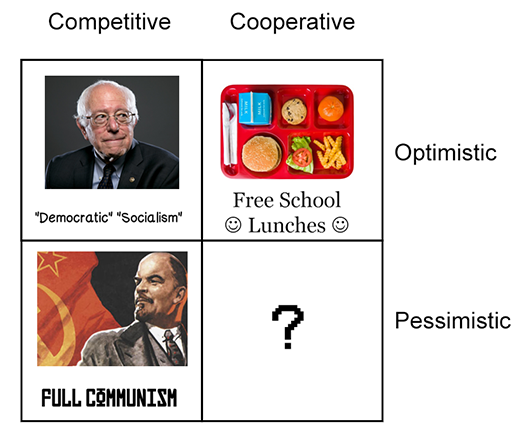
People seem to split into a competitive versus a cooperative view of poverty. To massively oversimplify: competitives agree with deBoer that “inequality and immiseration are the very purpose of capitalism” and conceive of ending poverty in terms of stopping exploitation and giving the poor their “just due” that the rich have taken away from them. The cooperatives argue that everyone is working together to create a nice economy that enriches everybody who participates in it, but some people haven’t figured out exactly how to plug into the magic wealth-generating machine, and we should give them a helping hand (“here’s government-subsidized tuition to a school where you can learn to code!”). Probably nobody’s 100% competitive or 100% cooperative, but I think a lot of people have a tendency to view the problem more one way than the other.
So the northwest corner of the grid is people who think the problem is primarily one of exploitation, but it’s at least somewhat tractable to reform. No surprises here – these are the types who think that the big corporations are exploiting people, but if average citizens try hard enough they can make the Man pay a $15 minimum wage and give them free college tuition, and then with enough small victories like these they can level the balance enough to give everybody a chance.
(These are all going to be straw men, but hopefully useful straw men)
The southwest corner is people who think the problem is primarily one of exploitation, but nothing within the system will possibly help. I put “full communism” in the little box, but I guess this could also be anarcho-syndicalism, or anarcho-capitalism, or theocracy, or Trumpism, or [insert your preferred poorly-planned form of government which inevitably fails here].
The northeast corner is people who think we’re all in this together and there are lots of opportunities to help. This is the QZ writer who said we should be focusing on “education and public services”. The economy is a benevolent force that wants to help everybody, but some people through bad luck – poor educational opportunities, not enough childcare, racial prejudice – haven’t gotten the opportunity they need yet, so we should lend them a helping hand so they can get back on their feet and one day learn to code. I named this quadrant “Free School Lunches” after all those studies that show that giving poor kids free school lunches improves their grades by X percent, which changes their chances of getting into a good college by Y percent, which increases their future income by Z percent, so all we have to do is have lots of social programs like free school lunches and then poverty is solved. But aside from the lunch people people, this category must also include libertarians who think that all we need to do is remove regulations that prevent the poor from succeeding, Reaganites who think that a rising tide will lift all boats, and conservatives who think the poor just need to be taught Traditional Hard-Working Values. Actually, probably 90% of the Overton Window is in this corner.
The southeast corner is people who think that we’re all in this together, but that helping the poor is really hard. They agree with the free school lunch crowd that capitalism is more the solution than the problem, and that we should think of this in terms of complicated impersonal social and educational factors preventing poor people from fitting into the economy. But the southeasterners worry school lunches won’t be enough. Maybe even hiring great teachers, giving everybody free health care, ending racism, and giving generous vocational training to people in need wouldn’t be enough. If we held a communist revolution, it wouldn’t do a thing: you can’t hold a revolution against skill mismatch. This is a very gloomy quadrant, and I don’t blame people for not wanting to be in it. But it’s where I spend most of my time.
The exploitation narrative seems fundamentally wrong to me – I’m not saying exploitation doesn’t happen, nor even that it isn’t common, just that isn’t not the major factor causing poverty and social decay. The unnecessariat article, for all its rage against Silicon Valley hogging the wealth, half-admits this – the people profiled have become unnecessary to the functioning of the economy, no longer having a function even as exploited proletarians. Silicon Valley isn’t exploiting these people, just ignoring them. Fears of technological unemployment are also relevant here: they’re just the doomsday scenario where all of us are relegated to the unnecessariat, the economy having passed us by.
But I also can’t be optimistic about programs to end poverty. Whether it’s finding out that schools and teachers have relatively little effect on student achievement, that good parenting has even less, or that differences in income are up to fifty-eight percent heritable and a lot of what isn’t outright genetic is weird biology or noise, most of the research I read is very doubtful of easy (or even hard) solutions. Even the most extensive early interventions have underwhelming effects. We can spend the collective energy of our society beating our head against a problem for decades and make no headway. While there may still be low-hanging fruit – maybe an scaled-up Perry Preschool Project, lots of prenatal vitamins, or some scientist discovering a new version of the unleaded-gasoline movement – we don’t seem very good at finding it, and I worry it would be at most a drop in the bucket. Right now I think that a lot of variation in class and income is due to genetics and really deep cultural factors that nobody knows how to change en masse.
I can’t even really believe that a rising tide will lift all boats anymore. Not only has GDP uncoupled from median wages over the past forty years, but there seems to be a Red Queen’s Race where every time the GDP goes up the cost of living goes up the same amount. US real GDP has dectupled since 1900, yet a lot of people have no savings and are one paycheck away from the street. In theory, a 1900s poor person who suddenly got 10x his normal salary should be able to save 90% of it, build up a fund for rainy days, and end up in a much better position. In practice, even if the minimum wage in 2100 is $200 2016 dollar an hour, I expect the average 2100 poor person will be one paycheck away from the street. I can’t explain this, I just accept it at this point. And I think that aside from our superior technology, I would rather be a poor farmer in 1900 than a poor kid in the projects today. More southeast corner gloom.
The only public figure I can think of in the southeast quadrant with me is Charles Murray. Neither he nor I would dare reduce all class differences to heredity, and he in particular has some very sophisticated theories about class and culture. But he shares my skepticism that the 55 year old Kentucky trucker can be taught to code, and I don’t think he’s too sanguine about the trucker’s kids either. His solution is a basic income guarantee, and I guess that’s mine too. Not because I have great answers to all of the QZ article’s problems. But just because I don’t have any better ideas1,2.
The QZ article warns that it might create a calcified “perpetually under-employed stagnant underclass”. But of course we already have such an underclass, and it’s terrible. I can neither imagine them all learning to code, nor a sudden revival of the non-coding jobs they used to enjoy. Throwing money at them is a pretty subpar solution, but it’s better than leaving everything the way it is and not throwing money at them.
This is why I can’t entirely sympathize with any of the essays I read on poverty, eloquent though they are.
Footnotes
1. And then there’s the rest of the world. Given the success of export capitalism in Korea, Taiwan, China, Vietnam, et cetera, and the pattern where multinationals move to some undeveloped country with cheap labor, boost the local economy until the country is developed and labor there isn’t so cheap anymore, and then move on to the next beneficiary – solving international poverty seems a lot easier than solving local poverty. All we have to do is keep wanting shoes and plastic toys. And part of me wonders – if setting up a social safety net would slow domestic economic growth – or even divert money that would otherwise go to foreign aid – does that make it a net negative? Maybe we should be optimizing for maximum economic growth until we’ve maxed out the good we can do by industrializing Third World countries? My guess is that enough of the basic income debate is about how to use existing welfare payments that this wouldn’t be too big a factor. And I would hope (for complicated reasons), that basic income would be more likely to help than hurt the economy3.
2. Obviously invent genetic engineering and create a post-scarcity society, but until then we have to deal with this stuff.
3. And then there’s the whole open borders idea, which probably isn’t very compatible with basic income at all. Right now I think – I’ll explain at more length later – fully open borders is a bad idea, because the risk of it destabilizing the country and ruining the economic motor that lifts Third World countries out of poverty is too high.