Tumblr on MIRI
The post analyzes a debate about the effectiveness of MIRI, an AI safety organization, focusing on critiques of their academic output and defenses of their outreach efforts.
[Disclaimer: I have done odd jobs for MIRI once or twice several years ago, but I am not currently affiliated with them in any way and do not speak for them.]
A recent Tumblr conversation on the Machine Intelligence Research Institute has gotten interesting and I thought I’d see what people here have to say.
If you’re just joining us and don’t know about the Machine Intelligence Research Institute (“MIRI” to its friends), they’re a nonprofit organization dedicated to navigating the risks surrounding “intelligence explosion”. In this scenario, a few key insights around artificial intelligence can very quickly lead to computers so much smarter than humans that the future is almost entirely determined by their decisions. This would be especially dangerous since most AIs use very primitive untested goal systems inappropriate for and untested on intelligent entities; such a goal system would be “unstable” and from a human perspective the resulting artificial intelligence could have apparently arbitrary or insane goals. If such a superintelligence were much more powerful than we are, it would present an existential threat to the human race.
This has almost nothing to do with the classic “Skynet” scenario – but if it helps to imagine Skynet, then fine, just imagine Skynet. Everyone else does.
MIRI tries to raise awareness of this possibility among AI researchers, scientists, and the general public, and to start foundational research in more stable goal systems that might allow AIs to become intelligent or superintelligent while still acting in predictable and human-friendly ways.
This is not a 101 space and I don’t want the comments here to all be about whether or not this scenario is likely. If you really want to discuss that, go read at least Facing The Intelligence Explosion and then post your comments in the Less Wrong Open Thread or something. This is about MIRI as an organization.
(If you’re really just joining us and you don’t know about Tumblr, run away)
II.
Tumblr user su3su2u1 writes:
Saw some tumblr people talking about [effective altruism]. My biggest problem with this movement is that most everyone I know who identifies themselves as an effective altruist donates money to MIRI (it’s possible this is more a comment on the people I know than the effective altruism movement, I guess). Based on their output over the last decade, MIRI is primarily a fanfic and blog-post producing organization. That seems like spending money on personal entertainment.
Part of this is obviously mean-spirited potshots, in that MIRI itself doesn’t produce fanfic and what their employees choose to do with their own time is none of your damn business.
(well, slightly more complicated. I think MIRI gave Eliezer a couple weeks vacation to work on it as an “outreach” thing once. But that’s a little different from it being their main priority.)
But more serious is the claim that MIRI doesn’t do much else of value. I challenged Su3 with the following evidence of MIRI doing good work:
A1. MIRI has been very successful with outreach and networking – basically getting their cause noticed and endorsed by the scientific establishment and popular press. They’ve gotten positive attention, sometimes even endorsements, from people like Stephen Hawking, Elon Musk, Gary Drescher, Max Tegmark, Stuart Russell, and Peter Thiel. Even Bill Gates is talking about AI risk, though I don’t think he’s mentioned MIRI by name. Multiple popular books have been written about their ideas, such as James Miller’s Singularity Rising


A2. MIRI has many publications, conference presentations, book chapters and other things usually associated with normal academic research, which interested parties can find on their website. They have conducted seven past research workshops which have produced interesting results like Christiano et al’s claimed proof of a way around the logical undefinability of truth, which was praised as potentially interesting by respected mathematics blogger John Baez.
A3. Many former MIRI employees, and many more unofficial fans, supporters, and associates of MIRI, are widely distributed across the tech community in industries that are likely to be on the cutting edge of artificial intelligence. For example, there are a bunch of people influenced by MIRI in Google’s AI department. Shane Legg, who writes about how his early work was funded by a MIRI grant and who once called MIRI “the best hope that we have” was pivotal in convincing Google to set up an AI ethics board to monitor the risks of the company’s cutting-edge AI research. The same article mentions Peter Thiel and Jaan Tallinn as leading voices who will make Google comply with the board’s recommendations; they also happen to be MIRI supporters and the organization’s first and third largest donors.
There’s a certain level of faith required for (A1) and (A3) here, in that I’m attributing anything good that happens in the field of AI risk to some sort of shady behind-the-scenes influence from MIRI. Maybe Legg, Tallinn, and Thiel would have pushed for the exact same Google AI Ethics Board if none of them had ever heard of MIRI at all. I am forced to plead ignorance on the finer points of networking and soft influence. Heck, for all I know, maybe the exact same number of people would vote Democrat if there were no Democratic National Committee or liberal PACs. I just assume that, given a really weird idea that very few people held in 2000, an organization dedicated to spreading that idea, and the observation that the idea has indeed spread very far, the organization is probably doing something right.
III.
Our discussion on point (A3) degenerated into Dueling Anecdotal Evidence. But Su3 responded to my point (A1) like so:
[I agree that MIRI has gotten shoutouts from various thought leaders like Stephen Hawking and Elon Musk. Bostrom’s book is commercially successful, but that’s just] more advertising. Popular books aren’t the way to get researchers to notice you. I’ve never denied that MIRI/SIAI was good at fundraising, which is primarily what you are describing.
How many of those thought leaders have any publications in CS or pure mathematics, let alone AI? Tegmark might have a math paper or two, but he is primarily a cosmologist. The FLI’s list of scientists is (for some reason) mostly again cosmologists. The active researchers appear to be a few (non-CS, non-math) grad students. Not exactly the team you’d put together if you were actually serious about imminent AI risk.
I would also point out “successfully attracted big venture capital names” isn’t always a mark of a sound organization. Black Light Power is run by a crackpot who thinks he can make energy by burning water, and has attracted nearly 100 million in funding over the last two decades, with several big names in energy production behind him.
And to my point (A2) like so:
I have a PhD in physics and work in machine learning. I’ve read some of the technical documents on MIRI’s site, back when it was SIAI and I was unimpressed. I also note that this critique is not unique to me, as far as I know the GiveWell position on MIRI is that it is not an effective institute.
The series of papers on Lob’s theorem are actually interesting, though I notice that none of the results have been peer reviewed, and the paper’s aren’t listed as being submitted to journals yet. Their result looks right to me, but I wouldn’t trust myself to catch any subtlety that might be involved.
[But that just means] one result has gotten some small positive attention, and even those results haven’t been vetted by the wider math community yet (no peer review). Let’s take a closer look at the list of publications on MIRI’s website- I count 6 peer reviewed papers in their existence, and 13 conference presentations. Thats horribly unproductive! Most of the grad students who finish a physics phd will publish that many papers individually, in about half that time. You claim part of their goal is to get academics to pay attention, but none of their papers are highly cited, despite all this networking they are doing.
Citations are the standard way to measure who in academia is paying attention. Apart from the FHI/MIRI echo chamber (citations bouncing around between the two organizations), no one in academia seems to be paying attention to MIRI’s output. MIRI is failing to make academic inroads, and it has produced very little in the way of actual research.
My interpretation, in the form of a TL;DR
B1. Sure, MIRI is good at getting attention, press coverage, and interest from smart people not in the field. But that’s public relations and fundraising. An organization being good at fundraising and PR doesn’t mean it’s good at anything else, and in fact “so good at PR they can cover up not having substance” is a dangerous failure mode.
B2. What MIRI needs, but doesn’t have, is the attention and support of smart people within the fields of math, AI, and computer science, whereas now it mostly has grad students not in these fields.
B3. While having a couple of published papers might look impressive to a non-academic, people more familiar with the culture would know that their output is woefully low. They seem to have gotten about five ten solid publications in during their decade-long history as a multi-person organization; one good grad student can get a couple solid publications a year. Their output is less than expected by like an order of magnitude. And although they do get citations, this is all from a mutual back-scratching club of them and Bostrom/FHI citing each other.
IV.
At this point Tarn and Robby joined the conversation and it became kind of confusing, but I’ll try to summarize our responses.
Our response to Su3’s point (B1) was that this is fundamentally misunderstanding outreach. From its inception until about last year, MIRI was in large part an outreach and awareness-raising organization. Its 2008 website describes its mission like so:
In the coming decades, humanity will likely create a powerful AI. SIAI exists to confront this urgent challenge, both the opportunity and the risk. SIAI is fostering research, education, and outreach to increase the likelihood that the promise of AI is realized for the benefit of everyone.
Outreach is one of its three main goals, and “education”, which sounds a lot like outreach, is a second.
In a small field where you’re the only game in town, it’s hard to distinguish between outreach and self-promotion. If MIRI successfully gets Stephen Hawking to say “We need to be more concerned about AI risks, as described by organizations like MIRI”, is that them being very good at self-promotion and fundraising, or is that them accomplishing their core mission of getting information about AI risks to the masses?
Once again, compare to a political organization, maybe Al Gore’s anti-global-warming nonprofit. If they get the media to talk about global warming a lot, and get lots of public intellectuals to come out against global warming, and change behavior in the relevant industries, then mission accomplished. The popularity of An Inconvenient Truth can’t just be dismissed as “self-promotion” or “fundraising” for Gore, it was exactly the sort of thing he was gathering money and personal prestige in order to do, and should be considered a victory in its own right. Even though eventually the anti-global-warming cause cares about politicians, industry leaders, and climatologists a lot more than they care about the average citizen, convincing millions of average citizens to help was a necessary first step.
And this which is true of An Inconvenient Truth is true of Superintelligence and other AI risk publicity efforts, albeit on their much smaller scale.
Our response to Su3’s point (B2) was that it was just plain factually false. MIRI hasn’t reached big names from the AI/math/compsci field? Sure it has. Doesn’t have mathy PhD students willing to research for them? Sure it does.
Peter Norvig and Stuart Russell are among the biggest names in AI. Norvig is currently the Director of Research at Google; Russell is Professor of Computer Science at Berkeley and a winner of various impressive sounding awards. The two wrote a widely-used textbook on artificial intelligence in which they devote three pages to the proposition that “The success of AI might mean the end of the human race”; parts are taken right out of the MIRI playbook and they cite MIRI research fellow Eliezer Yudkowsky’s paper on the subject. This is unlikely to be a coincidence; Russell’s site links to MIRI and he is scheduled to participate in MIRI’s next research workshop.
Their “team” of “research advisors” includes Gary Drescher (PhD in CompSci from MIT), Steve Omohundro (PhD in physics from Berkeley but also considered a pioneer of machine learning), Roman Yampolskiy (PhD in CompSci from Buffalo), and Moshe Looks (PhD in CompSci from Washington).
Su3 brought up the good point that none of these people, respected as they are, are MIRI employees or researchers (although Drescher has been to a research workshop). At best, they are people who were willing to let MIRI use them as figureheads (in the case of the research advisors); at worst, they are merely people who have acknowledged MIRI’s existence in a not-entirely-unlike-positive way (Norvig and Russell). Even if we agree they are geniuses, this does not mean that MIRI has access to geniuses or can produce genius-level research.
Fine. All these people are, no more and no less, is evidence that MIRI is succeeding at outreach within the academic field of AI, as well as in the general public. It also seems to me to be some evidence that smart people who know more about AI than any of us think MIRI is on the right track.
Su3 brought up the example of a BlackLight Power, a crackpot energy company that was able to get lots of popular press and venture capital funding despite being powered entirely by pseudoscience. I agree this is the sort of thing we should be worried about. Nonscientists outside of specialized fields have limited ability to evaluate their claims. But when smart researchers in the field are willing to vouch for MIRI, that give me a lot more confidence they’re not just a fly-by-night group trying to profit off of pseudoscience. Their research might be more impressive or less impressive, but they’re not rotten to the core the same way BlackLight was.
And though MIRI’s own researchers may be far from those lofty heights, I find Su3’s claim that they are “a few non-CS, non-math grad students” a serious underestimate.
MIRI has fourteen employees/associates with the word “research” in their name, but of those, a couple (in the words of MIRI’s team page) “focus on social and historical questions related to artificial intelligence outcomes.” These people should not be expected to have PhDs in mathematical/compsci subjects.
Of the rest, Bill is a PhD in CompSci, Patrick is a PhD in math, Nisan is a PhD in math, Benja is a PhD student in math, and Paul is a PhD student in math. The others mostly have masters or bachelors in those fields, published journal articles, and/or won prizes in mathematical competitions. Eliezer writes of some of the remaining members of his team:
Mihaly Barasz is an International Mathematical Olympiad gold medalist perfect scorer. From what I’ve seen personally, I’d guess that Paul Christiano is better than him at math. I forget what Marcello’s prodigy points were in but I think it was some sort of Computing Olympiad [editor’s note: USACO finalist and 2x honorable mention in the Putnam mathematics competition]. All should have some sort of verified performance feat far in excess of the listed educational attainment.
That pretty much leaves Eliezer Yudkowsky, who needs no introduction, and Nate Soares, whose introduction exists and is pretty interesting.
Add to that the many, many PhDs and talented people who aren’t officially employed by them but attend their workshops and help out their research when they get the chance, and you have to ask how many brilliant PhDs from some of the top universities in the world we should expect a small organization like MIRI to have. MIRI competes for the same sorts of people as Google, and offers half as much. Google paid $400 million to get Shane Legg and his people on board; MIRI’s yearly budget hovers at about $1 million. Given that they probably spend a big chunk of that on office space, setting up conferences, and other incidentals, I think the amount of talent they have right now is pretty good.
That leaves Su3’s point (B3) – the lack of published research.
One retort might be that, until recently, MIRI’s research focused on strategic planning and evaluation of AI risks. This is important, and it resulted in a lot of internal technical papers you can find on their website, but there’s not really a field for it. You can’t just publish it in the Journal Of What Would Happen If There Was An Intelligence Explosion, because no such journal. The best they can do is publish the parts of their research that connect to other fields in appropriate journals, which they sometimes did.
I feel like this also frees them from the critique of citation-incest between them and Bostrom. When I look at a typical list of MIRI paper citations, I do see a lot of Bostrom, but also some other names that keep coming up – Hutter, Yampolskiy, Goetzel. So okay, it’s an incest circle of four or five rather than two.
But to some degree that’s what I expect from academia. Right now I’m doing my own research on a psychiatric screening tool called the MDQ. There are three or four research teams in three or four institutions who are really into this and publish papers on it a lot. Occasionally someone from another part of psychiatry wanders in, but usually it’s just the subsubsubspeciality of MDQ researchers talking to each other. That’s fine. They’re our repository of specialized knowledge on this one screening tool.
You would hope the future of the human race would get a little bit more attention than one lousy psychiatric screening tool, but blah blah civilizational inadequacy, turns out not so much, they’re of about equal size. If there are only a couple of groups working on this problem, they’re going to look incestuous but that’s fine.
On the other hand, math is math, and if MIRI is trying to produce real mathematical results they ought to be sharing them with the broader mathematical community.
Robby protests that until very recently, MIRI hasn’t really been focusing on math. This is a very recent pivot. In April 2013, Luke wrote in his mini strategic plan:
We were once doing three things — research, rationality training, and the Singularity Summit. Now we’re doing one thing: research. Rationality training was spun out to a separate organization, CFAR, and the Summit was acquired by Singularity University. We still co-produce the Singularity Summit with Singularity University, but this requires limited effort on our part.
After dozens of hours of strategic planning in January–March 2013, and with input from 20+ external advisors, we’ve decided to (1) put less effort into public outreach, and to (2) shift our research priorities to Friendly AI math research.
In the full strategic plan for 2014, he repeated:
Events since MIRI’s April 2013 strategic plan have increased my confidence that we are “headed in the right direction.” During the rest of 2014 we will continue to:
– Decrease our public outreach efforts, leaving most of that work to FHI at Oxford, CSER at Cambridge, FLI at MIT, Stuart Russell at UC Berkeley, and others (e.g. James Barrat).
– Finish a few pending “strategic research” projects, then decrease our efforts on that front, again leaving most of that work to FHI, plus CSER and FLI if they hire researchers, plus some others.
– Increase our investment in our Friendly AI (FAI) technical research agenda.
– We’ve heard that as a result of…outreach success, and also because of Stuart Russell’s discussions with researchers at AI conferences, AI researchers are beginning to ask, “Okay, this looks important, but what is the technical research agenda? What could my students and I do about it?” Basically, they want to see an FAI technical agenda, and MIRI is is developing that technical agenda already.
In other words, there is a recent pivot from outreach, rationality and strategic research to pure math research, and the pivot is only recently finished or still going on.
TL;DR, again in three points:
C1. Until recently, MIRI focused on outreach and did a truly excellent job on this. They deserve credit here.
C2. MIRI has a number of prestigious computer scientists and AI experts willing to endorse or affiliate with it in some way. While their own researchers are not quite at the same lofty heights, they include many people who have or are working on math or compsci PhDs.
C3. MIRI hasn’t published much math because they were previously focusing on outreach and strategic research; they’ve only shifted to math work in the past year or so.
V.
The discussion just kept going. We reached about the limit of our disagreement on (C1), the point about outreach – yes, they’ve done it, but does it count when it doesn’t bear fruit in published papers? About (C2) and the credentials of MIRI’s team, Su3 kind of blended it into the next point about published papers, saying:
Fundamental disconnect – I consider “working with MIRI” to mean “publishing results with them.” As an outside observer, I have no indication that most of these people are working with them. I’ve been to workshops and conferences with Nobel prize winning physicists, but I’ve never “worked with them” in the academic sense of having a paper with them. If [someone like Stuart Russell] is interested in helping MIRI, the best thing he could do is publish a well received technical result in a good journal with Yudkowsky. That would help get researchers to pay actual attention(and give them one well received published result, in their operating history).
Tangential aside- you overestimate the difficulty of getting top grad students to work for you. I recently got four CS grad students at a top program to help me with some contract work for a few days at the cost of some pizza and beer.
So it looks like it all comes down to the papers. Su3 had this to say:
What I was specifically thinking was “MIRI has produced a much larger volume of well-received fan fiction and blog posts than research.” That was what I inended to communicate, if somewhat snarkily. MIRI bills itself as a research institute, so I judge them on their produced research. The accountability measure of a research institute is academic citations.
Editorials by famous people have some impact with the general public, so thats fine for fundraising, but at some point you have to get researchers interested. You can measure how much influence they have on researchers by seeing who those researchers cite and what they work on. You could have every famous cosmologist in the world writing op-eds about AI risk, but its worthless if AI researchers don’t pay attention, and judging by citations, they aren’t.
As a comparison for publication/citation counts, I know individual physicists who have published more peer reviewed papers since 2005 than all of MIRI has self-published to their website. My single most highly cited physics paper (and I left the field after graduate school) has more citations than everything MIRI has ever published in peer reviewed journals combined. This isn’t because I’m amazing, its because no one in academia is paying attention to MIRI.
[Christiano et al’s result about Lob] has been self-published on their website. It has NOT been peer reviewed. So it’s published in the sense of “you can go look at the paper.” But its not published in the sense of “mathematicians in the same field have verified the result.” I agree this one result looks interesting, but most mathematicians won’t pay attention to it unless they get it reviewed (or at the bare minimum, clean it up and put it on Arxiv). They have lots of these self-published documents on their web page.
If they are making a “strategic decision” to not submit their self-published findings to peer review ,they are making a terrible strategic decision, and they aren’t going to get most academics to pay attention that way. The result of Christiano, et al. is potentially interesting, but it’s languishing as a rough unpublished draft on the MIRI site, so its not picking up citations.
I’d go further and say the lack of citations is my main point. Citations are the important measurement of “are researchers paying attention.” If everything self-published to MIRI’s website were sparking interest in academia, citations would be flying around, even if the papers weren’t peer reviewed, and I’d say “yeah, these guys are producing important stuff.”
My subpoint might be that MIRI doesn’t even seem to be trying to get citations/develop academic interest, as measured by how little effort seems to be put into publication.
And Su3’s not buying the pivot explanation either:
That seems to be a reframing of the past history though. I saw talks by the SIAI well before 2013 where they described their primary purpose as friendly AI research, and insisted they were in a unique position (due to being uniquely brilliant/rational) to develop technical friendly AI (as compared to academic AI researchers).
[Tarn] and [Robby] have suggested the organization is undergoing a pivot, but they’ve always billed themselves as a research institute. But donating money to an organization that has been ineffective in the past, because it looks like they might be changing seems like a bad proposition.
My initial impression (reading Muelhauser’s post you linked to and a few others) is that Muelhauser noticed the house was out of order when he became director and is working to fix things. Maybe he’ll succeed and in the future, then, I’ll be able to judge MIRI as effective- certainly a disproportionate number of their successes have come in the last few years. However, right now all I have is their past history, which has been very unproductive.
VI.
After that, discussion stayed focused on the issue of citations. This seemed like progress to me. Not only had we gotten it down to a core objection, but it was sort of a factual problem. It wasn’t an issue of praising or condemning. Here’s an organization with a lot of smart people. We know they work very hard – no one’s ever called Luke a slacker, and another MIRI staffer (who will not be named, for his own protection) achieved some level of infamy for mixing together a bunch of the strongest chemicals from my nootropics survey into little pills which he kept on his desk in the MIRI offices for anyone who wanted to work twenty hours straight and then probably die young of conditions previously unknown to science. IQ-point*hours is a weird metric, but MIRI is putting a lot of IQ-point*hours into whatever it’s doing. So if Su3’s right that there are missing citations, where are they?
Among the three of us, Robby and Tarn and I generated a couple of hypotheses (well, Robby’s were more like facts than hypotheses, since he’s the only one in this conversation who actually works there).
D1: MIRI has always been doing research, but until now it’s been strategic research (ie “How worried should we be about AI?”, “How far in the future should we expect AI to be developed?”) which hasn’t fit neatly into an academic field or been of much interest to anyone except MIRI allies like Bostrom. They have dutifully published this in the few papers that are interested, and it has dutifully been cited by the few people who are interested (ie Bostrom). It’s unreasonable to expect Stuart Russell to cite their estimates of time course for superintelligence when he’s writing his papers on technical details of machine learning algorithms or whatever it is he writes papers on. And we can generalize from Stuart Russell to the rest of the AI field, who are also writing on things like technical details of machine learning algorithms that can’t plausibly be connected to when machines will become superintelligent.
D2: As above, but continuing to apply even in some of their math-ier research. MIRI does have lots of internal technical papers on their website. People tend to cite other researchers working in the same field as themselves. I could write the best psychiatry paper in human history, and I’m probably not going to get any citations from astrophysicists. But “machine ethics” is an entirely new field that’s not super relevant to anyone else’s work. Although a couple key machine ethics problems, like the Lobian obstacle and decision theory, touch on bigger and better-populated subfields of mathematics, they’re always going to be outsiders who happen to wander in. It’s unfair to compare them to a physics grad student writing about quarks or something, because she has the benefit of decades of previous work on quarks and a large and very interested research community. MIRI’s first job is to create that field and community, which until you succeed looks a lot like “outreach”.
D3: Lack of staffing and constant distraction by other important problems. This is Robby’s description of what he notices from the inside. He writes:
We’re short on staff, especially since Louie left. Lots of people are willing to volunteer for MIRI, but it’s hard to find the right people to recruit for the long haul. Most relevantly, we have two new researchers (Nate and Benja), but we’d love a full-time Science Writer to specialize in taking our researchers’ results and turning them into publishable papers. Then we don’t have to split as much researcher time between cutting-edge work and explaining/writing-down.
A lot of the best people who are willing to help us are very busy. I’m mainly thinking of Paul Christiano. he’s working actively on creating a publishable version of the probabilistic Tarski stuff, but it’s a really big endeavor. Eliezer is by far our best FAI researcher, and he’s very slow at writing formal, technical stuff. He’s generally low-stamina and lacks experience in writing in academic style / optimizing for publishability, though I believe we’ve been having a math professor tutor him to get over that particular hump. Nate and Benja are new, and it will take time to train them and get them publishing their own stuff. At the moment, Nate/Benja/Eliezer are spending the rest of 2014 working on material for the FLI AI conference, and on introductory FAI material to send to Stuart Russell and other bigwigs.
D4: Some of the old New York rationalist group takes a more combative approach. I’m not sure I can summarize their argument well enough to do it justice, so I would suggest reading Alyssa’s post on her own blog.
But if I have to take a stab: everyone knows mainstream academia is way too focused on the “publish or perish” ethic of measuring productivity in papers or citations rather than real progress. Yeah, a similar-sized research institute in physics could probably get ten times more papers/citations than MIRI. That’s because they’re optimizing for papers/citations rather than advancing the field, and Goodhart’s Law is in effect here as much as everywhere else. Those other institutes probably got geniuses who should be discovering the cure for cancer spending half their time typing, formatting, submitting, resubmitting, writing whatever the editors want to see, et cetera. MIRI is blessed with enough outside support that it doesn’t have to do that. The only reason to try is to get prestige and attention, and anyone who’s not paying attention now is more likely to be a constitutional skeptic using lack of citations as an excuse, than a person who would genuinely change their mind if there were more citations.
I am more sympathetic than usual to this argument because I’m in the middle of my own research on psychiatric screening tools and quickly learning that official, published research is the worst thing in the world. I could do my study in about two hours if the only work involved were doing the study; instead it’s week after week of forms, IRB submissions, IRB revisions, required online courses where I learn the Nazis did unethical research and this was bad so I should try not to be a Nazi, selecting exactly which journals I’m aiming for, and figuring out which of my bosses and co-workers academic politics requires me make co-authors. It is a crappy game, and if you’ve been blessed with enough independence to avoid playing it, why wouldn’t you take advantage? Forget the overhyped and tortured “measure” of progress you use to impress other people, and just make the progress.
VII.
Or not. I’ll let Su3 have the last word:
I think something fundamental about my argument has been missed, perhaps I’ve communicated it poorly.
It seems like you think the argument is that increasing publications increases prestige/status which would make researchers pay attention. i.e. publications -> citations -> prestige -> people pay attention. This is not my argument.
My argument is essentially that the way to judge if MIRI’s outreach has been successful is through citations, not through famous people name dropping them, or allowing them to be figure heads.
This is because I believe the goal of outreach is get AI researchers focused on MIRI’s ideas. Op eds from famous people are useful only if they get AI researchers focused on these ideas. Citations aren’t about prestige in this case- citations tell you which researchers are paying attention to you. The number of active researchers paying attention to MIRI is very small. We know this because citations are an easy to find, direct measure.
Not all important papers have tremendous numbers of citations, but a paper can’t become important if it only has 1 or 2, because the ultimate measure of importance is “are people using these ideas?”
So again, to reiterate, if the goal of outreach is to get active AI researchers paying attention, then the direct measure for who is paying attention is citations. [But] the citation count on MIRIs work is very low. Not only is the citation count low (i.e. no researchers are paying attention), MIRI doesn’t seem to be trying to boost it – it isn’t trying to publish which would help get its ideas attention. I’m not necessarily dismissive of celebrity endorsements or popular books, my point is why should I measure the means when I can directly measure the ends?
The same idea undercuts your point that “lots of impressive PhD students work and have worked with MIRI,” because it’s impossible to tell if you don’t personally know the researchers. This is because they don’t create much output while at MIRI, and they don’t seem to be citing MIRI in their work outside of MIRI.
[Even people within the rationalist/EA community] agree with me somewhat. Here is a relevant quote from Holden Karnofsky [of GiveWell]:
SI seeks to build FAI and/or to develop and promote “Friendliness theory” that can be useful to others in building FAI. Yet it seems that most of its time goes to activities other than developing AI or theory. Its per-person output in terms of publications seems low. Its core staff seem more focused on Less Wrong posts, “rationality training” and other activities that don’t seem connected to the core goals; Eliezer Yudkowsky, in particular, appears (from the strategic plan) to be focused on writing books for popular consumption. These activities seem neither to be advancing the state of FAI-related theory nor to be engaging the sort of people most likely to be crucial for building AGI.
And here is a statement from Paul Christiano disagreeing with MIRI’s core ideas:
But I should clarify that many of MIRI’s activities are motivated by views with which I disagree strongly and that I should categorically not be read as endorsing the views associated with MIRI in general or of Eliezer in particular. For example, I think it is very unlikely that there will be rapid, discontinuous, and unanticipated developments in AI that catapult it to superhuman levels, and I don’t think that MIRI is substantially better prepared to address potential technical difficulties than the mainstream AI researchers of the future.
This time Su3 helpfully provides their own summary:
E1. If the goal of outreach is to get active AI researchers paying attention, then the direct measure for who is paying attention is citations. [But] the citation count on MIRIs work is very low.
E2. Not only is the citation count low (i.e. no researchers are paying attention), MIRI doesn’t seem to be trying to boost it – it isn’t trying to publish which would help get its ideas attention. I’m not necessarily dismissive of celebrity endorsements or popular books, my point is why should I measure the means when I can directly measure the ends?
E3. The same idea undercuts your point that “lots of impressive phd students work and have worked with MIRI,” because its impossible to tell if you don’t personally know the researchers. This is because they don’t create much output while at MIRI, and they don’t seem to be citing MIRI in their work outside of MIRI.
E4. Holden Karnofsky and Paul Christiano do not believe that MIRI is better prepared to address the friendly AI problem than mainstream AI researchers of the future. Karnofsky explicitly for some of the reasons I have brought up, Christiano for reasons unmentioned.
VIII.
Didn’t actually read all that and just skipped down to the last subheading to see if there’s going to be a summary and conclusion and maybe some pictures? Good.
There seems to be some agreement MIRI has done a good job bringing issues of AI risk into the public eye and getting them media attention and the attention of various public intellectuals. There is disagreement over whether they should be credited for their success in this area, or whether this is a first step they failed to follow up on.
There also seems to be some agreement MIRI has done a poor job getting published and cited results in journals. There is disagreement over whether this is an understandable consequence of being a small organization in a new field that wasn’t even focusing on this until recently, or whether it represents a failure at exactly the sort of task by which their success should be judged.
This is probably among the 100% of issues that could be improved with flowcharts:
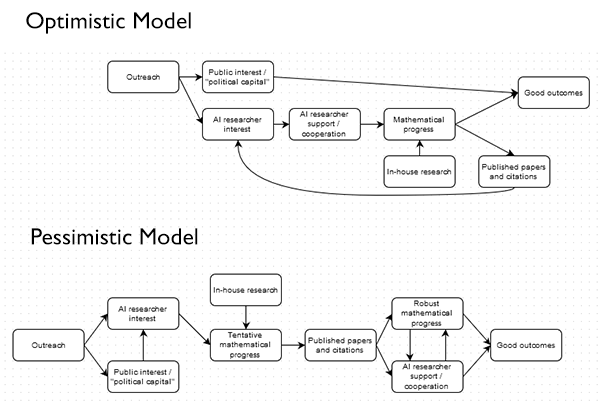 In the Optimistic Model, MIRI’s successfully built up Public Interest, and for all we know they might have Mathematical Progress as well even though they haven’t published it in journals yet. While they could feed back their advantages by turning their progress into Published Papers and Citations to get even more Mathematical Progress, overall they’re in pretty good shape for producing Good Outcomes, at least insofar as this is possible in their chosen field.
In the Pessimistic Model, MIRI may or may not have garnered Public Interest, Researcher Interest, and Tentative Mathematical Progress, but they failed to turn that into Published Papers and Citations, which is the only way they’re going to get to Robust Mathematical Progress, Researcher Support, and eventually Good Outcomes. The best that can be said about them is that they set some very preliminary groundwork that they totally failed to follow up on.
A higher level point – if we accept the Pessimistic Model, do we accuse MIRI of being hopelessly incompetent, in which case they deserve less support? Or do we accept them as inexperienced amateurs who are the only people willing to try something difficult but necessary, in which case they deserve more support, and maybe some guidance, and perhaps some gentle or not-so-gentle prodding? Maybe if you’re a qualified science writer you could apply for the job opening they’re advertising and help them get those papers they need?
An even higher-level point – what do people worried about AI risk do with this information? I don’t see much that changes my opinion of the organization one way or the other. But Robby points out that people who are more concerned – but still worried about AI risk – have other good options. The Future of Humanity Institute at Oxford research that is less technical and more philosophical, wears their strategic planning emphasis openly on their sleeve has oodles of papers and citations and prestige. They also accept donations.
Best of all, their founder doesn’t write any fanfic at all. Just perfectly respectable stories about evil dragon kings.
