Untitled
Scott Alexander critiques feminist stereotyping of nerds, arguing that nerds' social struggles are real and not simply male entitlement.
EDIT: This is the most controversial post I have ever written in ten years of blogging. I wrote it because I was very angry at a specific incident. I stand by a lot of it, but if somebody links you here saying “HERE’S THE SORT OF GUY THIS SCOTT ALEXANDER PERSON IS, READ THIS SO YOU KNOW WHAT HIS BLOG IS REALLY ABOUT”, please read any other post instead. There’s a whole list of Top Posts on the Top Posts bar above.
Trigger warning: social justice, condemnation of some feminism, tangential reference to eating disorder. Note that although our names are very similar, I am NOT the same person as Scott Aaronson and he did NOT write this article. Not meant as a criticism of feminism, so much as of a certain way of operationalizing feminism.
I.
In my heart, there is a little counter that reads “XXX days without a ten-thousand word rant about feministm.” And I had just broken three digits when they had to go after Scott Aaronson.
For those of you who don’t know, Scott Aaronson is one of the nicest, smartest, and most decent people there are. A few days ago, in response to a discussion of sexual harassment at MIT, Aaronson reluctantly opened up about his experience as a young man:
> I check Feministing, and even radfem blogs like “I Blame the Patriarchy.” And yes, I’ve read many studies and task force reports about gender bias, and about the “privilege” and “entitlement” of the nerdy males that’s keeping women away from science. Alas, as much as I try to understand other people’s perspectives, the first reference to my “male privilege”—my privilege!—is approximately where I get off the train, because it’s so alien to my actual lived experience. > > But I suspect the thought that being a nerdy male might not make me “privileged”—that it might even have put me into one of society’s least privileged classes—is completely alien to your way of seeing things. To have any hope of bridging the gargantuan chasm between us, I’m going to have to reveal something about my life, and it’s going to be embarrassing. > > (sigh) Here’s the thing: I spent my formative years—basically, from the age of 12 until my mid-20s—feeling not “entitled,” not “privileged,” but terrified. I was terrified that one of my female classmates would somehow find out that I sexually desired her, and that the instant she did, I would be scorned, laughed at, called a creep and a weirdo, maybe even expelled from school or sent to prison. You can call that my personal psychological problem if you want, but it was strongly reinforced by everything I picked up from my environment: to take one example, the sexual-assault prevention workshops we had to attend regularly as undergrads, with their endless lists of all the forms of human interaction that “might be” sexual harassment or assault, and their refusal, ever, to specify anything that definitely wouldn’t be sexual harassment or assault. I left each of those workshops with enough fresh paranoia and self-hatred to last me through another year. > > My recurring fantasy, through this period, was to have been born a woman, or a gay man, or best of all, completely asexual, so that I could simply devote my life to math, like my hero Paul Erdös did. Anything, really, other than the curse of having been born a heterosexual male, which for me, meant being consumed by desires that one couldn’t act on or even admit without running the risk of becoming an objectifier or a stalker or a harasser or some other creature of the darkness. > > Of course, I was smart enough to realize that maybe this was silly, maybe I was overanalyzing things. So I scoured the feminist literature for any statement to the effect that my fears were as silly as I hoped they were. But I didn’t find any. On the contrary: I found reams of text about how even the most ordinary male/female interactions are filled with “microaggressions,” and how even the most “enlightened” males—especially the most “enlightened” males, in fact—are filled with hidden entitlement and privilege and a propensity to sexual violence that could burst forth at any moment. > > Because of my fears—my fears of being “outed” as a nerdy heterosexual male, and therefore as a potential creep or sex criminal—I had constant suicidal thoughts. As Bertrand Russell wrote of his own adolescence: “I was put off from suicide only by the desire to learn more mathematics.” > > At one point, I actually begged a psychiatrist to prescribe drugs that would chemically castrate me (I had researched which ones), because a life of mathematical asceticism was the only future that I could imagine for myself. The psychiatrist refused to prescribe them, but he also couldn’t suggest any alternative: my case genuinely stumped him. As well it might—for in some sense, there was nothing “wrong” with me. In a different social context—for example, that of my great-grandparents in the shtetl—I would have gotten married at an early age and been completely fine. (And after a decade of being coy about it, I suppose I’ve finally revealed the meaning of this blog’s title.) […] > > Now, the whole time I was struggling with this, I was also fighting a second battle: to maintain the liberal, enlightened, feminist ideals that I had held since childhood, against a powerful current pulling me away from them. I reminded myself, every day, that no, there’s no conspiracy to make the world a hell for shy male nerds. There are only individual women and men trying to play the cards they’re dealt, and the confluence of their interests sometimes leads to crappy outcomes. No woman “owes” male nerds anything; no woman deserves blame if she prefers the Neanderthals; everyone’s free choice demands respect. > > That I managed to climb out of the pit with my feminist beliefs mostly intact, you might call a triumph of abstract reason over experience. But I hope you now understand why I might feel “only” 97% on board with the program of feminism.
All right. Guy opens up for the first time about how he was so terrified of accidentally hurting women that he became suicidal and tried to get himself castrated. Eventually he got over it and is now 97% on board with feminism, but wants people to understand that when done wrong it can be really scary.
The feminist blogosphere, as always, responded completely proportionally. Amanda Marcotte, want to give us a representative sample?
> [Aaronson’s post] is the whole “how can men be oppressed when I don’t get to have sex with all the hot women that I want without having to work for it?” whine, one that, amongst other things, starts on the assumption that women do not suffer things like social anxiety or rejection…It was just a yalp of entitlement combined with an aggressive unwillingness to accept that women are human beings just like men. [He is saying that] “having to explain my suffering to women when they should already be there, mopping my brow and offering me beers and blow jobs, is so tiresome…I was too busy JAQ-ing off, throwing tantrums, and making sure the chip on my shoulder was felt by everyone in the room to be bothered to do something like listen.” Women are failing him by not showing up naked in his bed, unbidden. Because bitches, yo. > > The eternal struggle of the sexist: Objective reality suggests that women are people, but the heart wants to believe they are a robot army put here for sexual service and housework.
This would usually be the point where I state for the record that I believe very strongly that all women are human beings. Problem is, I’ve just conceived a sudden suspicion that one of them is actually a Vogon spy in a skin suit.
Anyway, Marcotte was bad enough, given that she runs one of the most-read feminist blogs on the Internet. But much of the rest of the feminist “discussion” on Tumblr, Twitter, and the like was if anything even worse.
But there was one small ray of hope. A bunch of people sent me an article on the issue by Laurie Penny in New Statesman, called “On Nerd Entitlement: White Male Nerds Need To Recognize That Other People Had Traumatic Upbringings Too And That’s Different From Structural Oppression.” The article was always linked with commentary like “This is so compassionate!” or “Finally a decent human being is addressing this issue with kindness!”
Well, I read the article, and ended up having the following Facebook conversation:
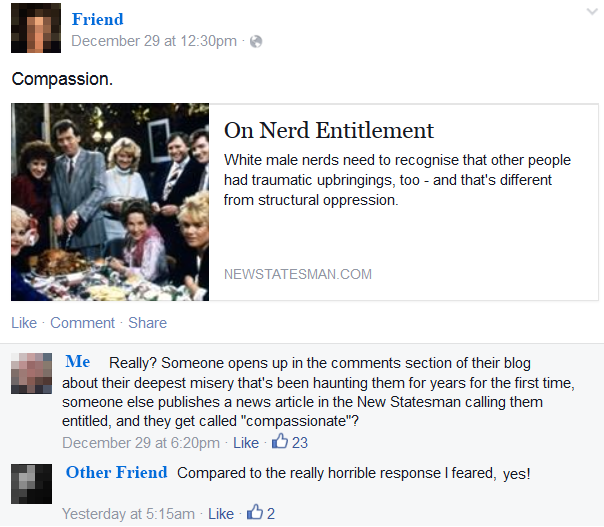 On further reflection, Other Friend has a point. I disliked Penny’s article, but compared to everything else it was a ray of light, a breath of fresh air, an unexpected incursion from a utopia of universal love and understanding. I didn’t feel like it treated Aaronson fairly. But I did feel like it treated him like a human being, which is rare and wonderful.
From the article:
I do not intend for a moment to minimise Aaronson’s suffering. Having been a lonely, anxious, horny young person who hated herself and was bullied I can categorically say that it is an awful place to be. I have seen responses to nerd anti-feminism along the lines of “being bullied at school doesn’t make you oppressed”. Maybe it’s not a vector of oppression in the same way, but it’s not nothing. It burns. It takes a long time to heal.
That this article keeps being praised effusively for admitting that someone else’s suicidal suffering “isn’t nothing”, is a sign. It’s a sign of how low our standards are. But it’s also a sign people are ready for change.
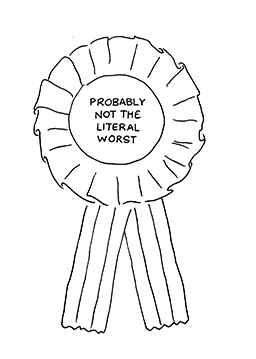
It’s hard for me express simultaneously both how genuinely grateful and impressed I am that the article managed to avoid being awful, and how far I still think it has to go. I can only offer Ms. Penny and the entire staff of the New Statesman the recognition appropriate for their achievement:
 I’ve already written some thoughts on this general issue in Radicalizing The Romanceless. But by bringing nerd-dom into the picture, Penny has made that basic picture exponentially more complicated.
Luckily, this is a post about Scott Aaronson, so things that become exponentially more complicated fit the theme perfectly.
II.
Ms. Penny writes:
Feminism is not to blame for making life hell for “shy, nerdy men”. It is a real shame that Aaronson picked up Andrea Dworkin rather than any of the many feminist theorists and writers who manage to combine raw rage with refusal to resort to sexual shame as an instructive tool. Weaponised shame – male, female or other – has no place in any feminism I subscribe to.
I live in a world where feminists throwing weaponized shame at nerds is an obvious and inescapable part of daily life. Whether we’re “mouth-breathers”, “pimpled”, “scrawny”, “blubbery”, “sperglord”, “neckbeard”, “virgins”, “living in our parents’ basements”, “man-children” or whatever the insult du jour is, it’s always, always, ALWAYS a self-identified feminist saying it. Sometimes they say it obliquely, referring to a subgroup like “bronies” or “atheists” or “fedoras” while making sure everyone else in nerddom knows it’s about them too.
There continue to be a constant stream of feminist cartoons going around Tumblr featuring blubberous neckbearded fedora-wearing monsters threatening the virtue of innocent ladies.
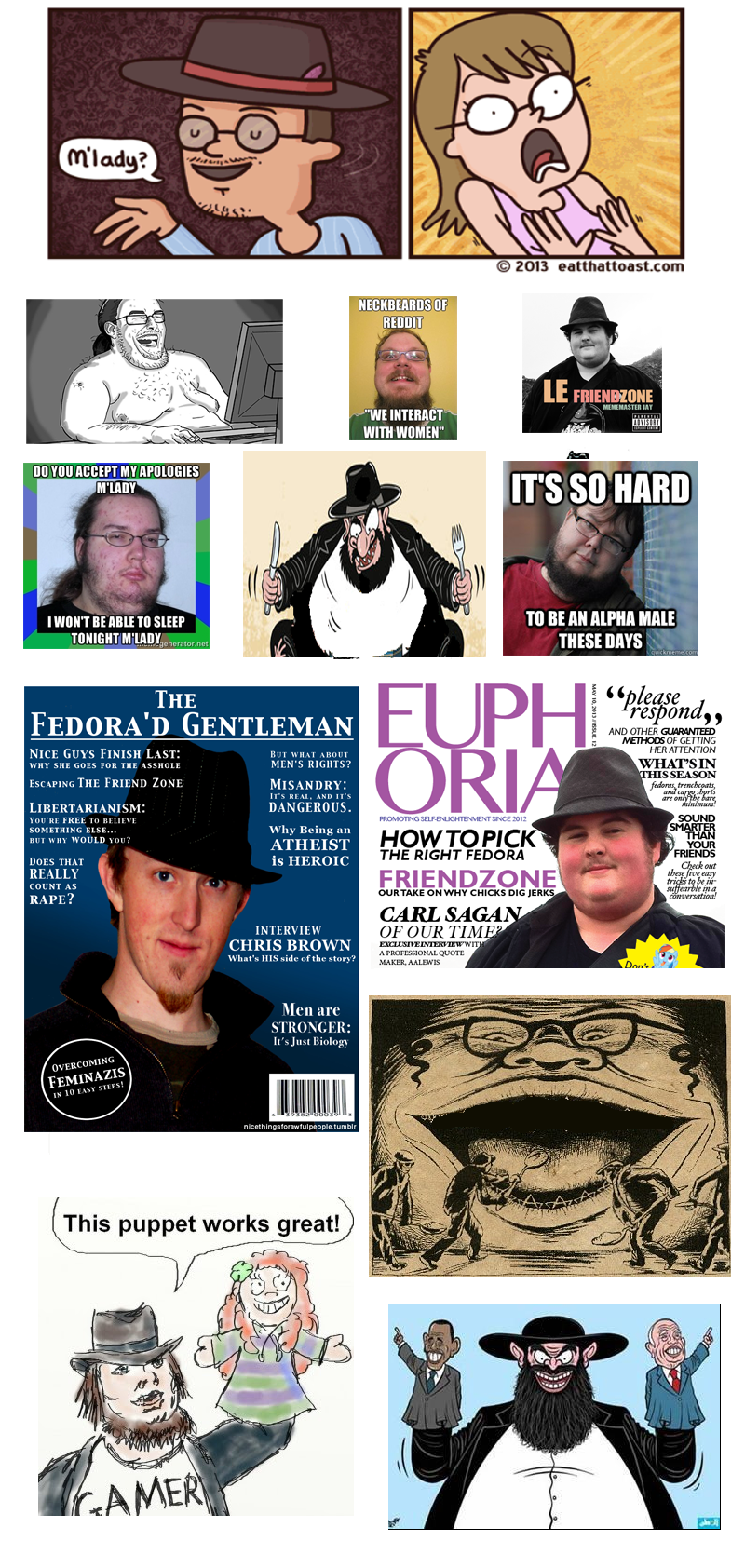
Read any article from the appropriate subfield of feminism, and you may well run into the part with the girl walking into a comic book store only to be accosted by a mouth-breathing troglodyte, followed by a “lesson” on nerd male privilege.
But it’s not just that. Try to look up something on Iron Man, and you get an article on Iron Man-Child and how “the white maleness of geek culture” proves they are “the most useless and deficient individuals in society, precisely because they have such a delusional sense of their own importance and entitlements.” Go to Jezebel and people are talking about how jocks are so much better than nerds because nerds hate women.
It has reached the point where articles published in major journals talk about the the fedora phenomenon in the context of “the growing trend in feminists and other activists online that use shaming as an activist strategy”.
Let’s not mince words. There is a growing trend in Internet feminism that works exactly by conflating the ideas of nerd, misogynist, virgin, person who disagrees with feminist tactics or politics, and unlovable freak.
Ms. Penny may be right that her ideal feminism doesn’t do that. Then again, my ideal masculinity doesn’t involve rape or sexual harassment. Ideals are always pretty awesome. But women still have the right to complain when actual men rape them, and I’m pretty sure nerds deserve the right to complain that actual feminists are, a lot of the time, focused way more on nerd-baiting than actual feminism, and that much the same people who called us “gross” and “fat” and “loser” in high school are calling us “gross” and “misogynist” and “entitled” now, and for much the same reasons.
III.
Penny goes on to deny that this is a gendered issue at all:
Like Aaronson, I was terrified of making my desires known- to anyone. I was not aware of any of my (substantial) privilege for one second – I was in hell, for goodness’ sake, and 14 to boot…Scott, imagine what it’s like to have all the problems you had and then putting up with structural misogyny on top of that. Or how about a triple whammy: you have to go through your entire school years again but this time you’re a lonely nerd who also faces sexism and racism.
This comes across so strongly as “my suffering is worse than your suffering” spiel, so much so that I’m tempted to argue it and review a bunch of experiments like how even the least attractive women on dating sites get far more interest than men. Or how women asking random people for sex on the street get accepted more than two-thirds of the time, but men trying the same get zero percent. Or how the same study shows that the women who get declined get declined politely, while the men are treated with disgust and contempt. Or I could hunt down all of the stories of trans men who start taking testosterone, switch to a more male sex drive, and are suddenly like “OH MY GOD I SUDDENLY REALIZE WHAT MALE HORNINESS IS LIKE I THOUGHT I KNEW SEXUAL FRUSTRATION BEFORE BUT I REALLY REALLY DIDN’T HOW DO YOU PEOPLE LIVE WITH THIS?”
But my commenters have convinced me that taking this further would be joining in the pissing contest I’m condemning, so let’s put it a little differently.
A couple of studies show that average-attractiveness people who ask random opposite-gender strangers on dates are accepted 50% of the time, regardless of their gender.
Grant that everyone involved in this conversation has admitted they consider themselves below average attractiveness (except maybe Marcotte, whose daily tune-ups keep her skin-suit in excellent condition). Fine. Maybe we have a success rate of 10%?
That’s still astounding. It would be pretty easy to mock teenage-me for not asking for dates when ten percent of people would have said yes. Asking ten people something takes what, five minutes? And would have saved how many years of misery?
This is a pretty impressive market failure – in sheer utility cost, probably bigger than any of the market failures actual economists talk about.
Some people say the female version of the problem is men’s fault, and call the behavior involve slut-shaming. I take this very seriously and try not to slut-shame or tolerate those who do.
But the male version of the problem is nerd-shaming or creep-shaming or whatever, and I don’t feel like most women, especially most feminist women, take it nearly as seriously as I try to take their problems. If anything, many actively make it worse. This is exactly those cartoons above and the feminists spreading them. Nerds are told that if they want to date girls, that makes them disgusting toxic blubberous monsters who are a walking offense to womankind.
This is maybe not the most reasonable interpretation of modern sexual mores, but neither is “any women who has sex before marriage is a slut and no one will ever value her.” Feminists are eagle-eyed at spotting the way seemingly innocuous messages in culture can accidentally reinforce the latter, but continue to insist that there’s no possible way that shouting the former from the rooftops could possibly lead to anyone believing or internalizing it.
Talking about “entitled nerds” is the Hot New Internet Feminism thing these days. Here’s The Entitlement And Misogyny Of Nerd Culture. Here’s Sex, Nerds, Entitlement, and Rape. Here’s Is Nerd Culture Filled With Entitled Crybabies? There’s On Male Entitlement: Geeks, Creeps, and Sex.
And now, apparently, the New Statesman, realizing that it’s almost 2015 and it has yet to claim a share of the exciting nerd entitlement action, has On Nerd Entitlement by Laurie Penny
And this is more than a little weird, because the actual nerds I know in real life tend to be more like Scott Aaronson, who is spending less time feeling entitled to sex, and more time asking his doctor if there’s any way to get him castrated because his sexual desire might possibly offend a woman. Or more like me, who got asked out by a very pretty girl in middle school and ran away terrified because he knew nobody could actually like him and it was obviously some kind of nasty trick.
So given that real-life nerds are like this, and given that they’re sitting around being terrified that they’re disgusting toxic monsters whose wish to have sex is an offense against womankind, what do you think happens when they hear from every news source in the world that they are entitled?
What happens is they think “Oh God! There was that one time when I looked at a woman and almost thought about asking her out! That means I must be feeling entitled to sex! I had temporarily forgotten that as a toxic monster I must never show any sexuality to anybody! Oh God oh God I’m even worse than I thought!”
Again, this is not the most rational thing in the world. But I maintain it’s no less rational than, say, women who won’t leave their abusive husband because he’s convinced them they don’t deserve anything better than what they get. Gender is weird. Self-loathing is easy to inculcate and encourage, even unintentionally. Heck, we’ve already identified this market failure of people preferring to castrate themselves rather than ask ten people on a date, something weird has got to explain it.
When feminists say that the market failure for young women is caused by slut-shaming, I stop slut-shaming, and so do most other decent people.
When men say that the market failure for young men is caused by nerd-shaming, feminists write dozens of very popular articles called things like “On Nerd Entitlement”.
The reason that my better nature thinks that it’s irrelevant whether or not Penny’s experience growing up was better or worse than Aaronson’s: when someone tells you that something you are doing is making their life miserable, you don’t lecture them about how your life is worse, even if it’s true. You STOP DOING IT.
IV.
This also serves to illuminate what I think is the last and most important difference between Penny’s experience and Aaronson’s experience.
When Penny bares her suffering to the world for all to hear about, she gets sympathy, she gets praised as compassionate, she gets published in important magazines whose readers feel sorry for her and acknowledge that her experience sucks.
When Aaronson talks about his suffering on his own blog, he gets Amanda Marcotte. He gets half the internet telling him he is now the worst person in the world.
This was my experience as well. When I complained that I felt miserable and alone, it was like throwing blood in the water. A feeding frenzy of feminists showed up to tell me I was a terrible person and deserved to die, sometimes in terms that made Marcotte look like grandmotherly kindness. This is part of the experience I write about in this post, and it’s such a universal part of the shy awkward male experience that we are constantly flabbergasted that women refuse to accept it exists.
When feminists write about this issue, they nearly always assume that the men involved are bitter about all the women who won’t sleep with them. In my experience and the experience of everyone I’ve ever talked to, we’re bitter about all the women who told us we were disgusting rapists when we opened up about our near-suicidal depression.
And when that happens, again and again and again, of course we learn to shut up about it. I bottled my feelings inside and never let them out and spent years feeling like I was a monster for even having them.
As a mental health professional, I can assure you this is the best coping strategy.
V.
Laurie Penny has an easy answer to any claims that any of this is feminists’ fault:
Feminism, however, is not to blame for making life hell for “shy, nerdy men”. Patriarchy is to blame for that.
I say: why can’t it be both?
Patriarchy is yet another motte and bailey trick.
The motte is that patriarchy is the existence of different gender roles in our society and the ways in which they are treated differently.
The bailey is that patriarchy is men having power over women.
If you allow people to switch between these and their connotations willy-nilly, then you enable all sorts of mischief.
Whenever men complain about anything, you say “Oh, things are bad for men? Well, that sounds like a gender role. Patriarchy’s fault!”
And then the next day you say “Well, since we already agreed yesterday your problem is patriarchy, the solution is take away power from men and give it to women. It’s right there in the word, patri-archy. So what we need is more feminism.”
Even if in this particular case the feminism is making the problem worse.
So, for example, we are told that the patriarchy causes male rape. We are told that if we want to fight male rape, the best way to do so is to work hard to promote feminist principles. But once feminism has been promoted, the particular feminists benefitting from that extra social capital may well be the ones to successfully lobbying national governments to keep male rape legal on the ground that if raping men was illegal, they might make false accusations which could hurt women.
If patriarchy is “any problem with gender roles”, it’s entirely possible, even predictable, that feminists can be the ones propping it up in any given situation.
I mean, we live in a world where the Chinese Communist Party is the group that enforces Chinese capitalism and oppresses any workers who complain about it. We live in a world where the guy who spoke out against ritualized purity-obsessed organized religion ended up as the founder of the largest ritualized purity-obsessed organized religion of all time. We live in a world where the police force, which is there to prevent theft and violence, is confiscating property and shooting people right and left. It seems neither uncommon nor unexpected that if you charge a group with eliminating an evil that’s really hard to eliminate, they usually end up mildly tweaking the evil into a form that benefits them, then devoting most of their energy to punishing people who complain.
Pick any attempt to shame people into conforming with gender roles, and you’ll find self-identified feminists leading the way. Transgender people? Feminists led the effort to stigmatize them and often still do. Discrimination against sex workers? Led by feminists. Against kinky people? Feminists again. People who have too much sex, or the wrong kind of sex? Feminists are among the jeering crowd, telling them they’re self-objectifying or reinforcing the patriarchy or whatever else they want to say. Male victims of domestic violence? It’s feminists fighting against acknowledging and helping them.
Yes, many feminists have been on both sides of these issues, and there have been good feminists tirelessly working against the bad feminists. Indeed, right now there are feminists who are telling the other feminists to lay off the nerd-shaming. My girlfriend is one of them. But that’s kind of my point. There are feminists on both sides of a lot of issues, including the important ones.
(“But nowadays in 2015 most feminists are on the right side of every gender issue, right?” Insofar as your definition of ‘the right side of a gender issue’ is heavily influenced by ‘the side most feminists are on’, I’m going to have a really hard time answering that question in a non-tautologous way. Come back in 2065 and we can have a really interesting discussion about whether the feminists of 2015 screwed up as massively as the feminists of 1970 and 1990 did.)
So feminists can be either against or in favor of “patriarchy” broadly defined. Whether or not a form of cruelty is decreed to be patriarchy doesn’t tell us how many feminists are among the people twisting the knife.
The preferred method of figuring this out is asking the people involved.
I’ve been saying for years that getting exposed to feminist shaming was part of what made my adolescence miserable. Every time I say this, I get a stream of grateful emails thanking me for saying something so true to their experience.
Scott Aaronson has now said that getting exposed to feminist shaming was part of what made his adolescence miserable. According to his most recent blog post, he’s also getting the stream of grateful emails:
Throughout the past two weeks, I’ve been getting regular emails from shy nerds who thanked me profusely for sharing as I did, for giving them hope for their own lives, and for articulating a life-crushing problem that anyone who’s spent a day among STEM nerds knows perfectly well, but that no one acknowledges in polite company. I owe the writers of those emails more than they owe me, since they’re the ones who convinced me that on balance, I did the right thing.
I hang out a lot with shy awkward nerdy men of all ages, and I very often hear from them that feminist shaming is part of what’s making their adolescence (and often current life) miserable.
And it’s not just men. Here’s what a lesbian friend of mine had to say about Penny’s article:
There are a hell of a lot of people attracted to women who seem to have internalized the message that their attraction makes them sick and wrong and evil and creepy, that basically any interaction they have with a woman is coercive or harmful on their part, and that initiating a romantic interaction makes them a sexual predator.
I know this because I’m one of them.
I’m a woman. I’m gay. By the time I realized that second thing, I’d internalized that all attraction to women was objectifying and therefore evil. I spent years of my life convinced that it was coercive to make it clear to girls that I wanted to date them, lest they feel pressured. So I could only ask them out with a clear conscience if I was in fact totally indifferent to their answer. I still decide I’m abusive pretty frequently, on the basis of things like ‘i want to kiss her, which is what an abuser would want’ and ‘i want to be special to her, which is what an abuser would want’.
I internalized these messages from exposure to feminist memes, norms, and communities. It was feminist messages, not homophobic ones, that made it hardest for me to come to terms with my sexuality. It wasn’t intentional. But it happened. And it has happened by now to enough people that ‘well obviously you’re misinterpreting it’ is starting to wear thin as an excuse. Lots and lots of people are misinterpreting the way I did. By and large, we’re vulnerable people. Very often we’re mentally ill or disabled people.
Even if it’s broadly good for feminism to emphasize narratives about objectification and entitlement, this seems like a negative consequence of the way contemporary feminist activism does that. Activism shouldn’t make vulnerable people suicidally guilty. If there was a way to do activism that didn’t have this consequence, it’d be better than the current setup.
The infuriating thing is that I think there might be. We could write articles acknowledging that certain conversations can exacerbate crippling guilt and self-loathing, particularly for people with anxiety, depression, or other mental illnesses that make them fixate on their own perceived worthlessness. We could really, truly, not-just-lip-service integrate concern for those people into our activism. We could acknowledge how common this experience is and have resources to help people. We could stop misidentifying anguish as entitlement, and stop acting like anguish that does have entitlement at its root is deserved or desirable or hilarious.
We could really just start by extending to men who share this experience with me the sympathy that I’m extended when I talk about it.
The responses on Tumblr from men and women all over the sexuality spectrum who have had any personal experience with this all say it’s how they feel as well.
I usually avoid the term “privilege” because it tends to start World War III when used. So let’s avoid the term and simply keep in mind the concept that people have private information about their own experience that it’s difficult for other people to get second-hand.
Ms. Penny, as an (I think?) heterosexual woman, has no idea what having to deal with our culture’s giant minefield around romance toward women is like.
Scott Aaronson is a straight guy, and he’s saying feminist shaming tactics have made it worse. I’m an asexual heteroromantic guy, and I’m telling her feminist shaming tactics have made it worse. Unitofcaring is a lesbian woman, and she’s saying feminist shaming tactics have made it worse. HughRistik, who is some sort of weird metrosexual something (I mock him because I love him), is telling her feminist shaming tactics have made it worse. A giant cry has arisen from shy awkward men, lesbians, bisexuals, whatever of the world is saying “NO, SERIOUSLY, FEMINIST SHAMING TACTICS ARE MAKING THIS WORSE”
When Ms. Penny protests that feminism can’t possibly be involved and all these other people’s s personal experience is wrong, this is coming from a place of startling arrogance. If patriarchy means everything in the world, then yes, it is the fault of patriarchy. But it’s the kind of patriarchy that feminism as a movement is working day in and day out to reinforce.
VI.
The subtitle of the article is “White male nerds need to recognise that other people had traumatic upbringings, too – and that’s different from structural oppression.”
This doesn’t really describe the argument very well. The closest it really comes is to say that:
Aaronson makes a sudden leap, and it’s a leap that comes right from the gut, from an honest place of trauma and post-rationalisation, from that teenage misery to a universal story of why nerdy men are in fact among the least privileged men out there, and why holding those men to account for the lack of representation of women in STEM areas – in the most important fields both of human development and social mobility right now, the places where power is being created and cemented right now – is somehow unfair […]
This is why Silicon Valley is fucked up. Because it’s built and run by some of the most privileged people in the world who are convinced that they are among the least.
I really fucking hope that it got better, or at least is getting better, At the same time, I want you to understand that that very real suffering does not cancel out male privilege, or make it somehow alright. Privilege doesn’t mean you don’t suffer, which, I know, totally blows.
The impression I’m getting is that yes, nerds think they have problems, but actually they’re really privileged. So their problems aren’t structural oppression in the same sense that women’s problems are. So. Quick hypothetical.
I’ve postulated before that “privilege” is a classic motte-and-bailey term. The motte, the uncontroversial and attractive definition, is “some people have built-in advantages over other people, and it might be hard for them to realize these advantages even exist”. Under this definition, it’s easy to agree that, let’s say, Aaronson has the privilege of not having to deal with slut-shaming, and Penny has the privilege of not having to deal with the kind of creep-shaming that focuses on male nerds.
The bailey, the sneaky definition used to push a political point once people have agreed to the motte, is that privilege is a one-dimensional axis such that for any two people, one has privilege over the other, and that first person has it better in every single way, and that second person has it worse in every single way.
This is of course the thing everyone swears they don’t mean when they use the word privilege, which is of course how the motte-and-bailey fallacy works. But as soon as they are not being explicitly challenged about the definition, this is the way they revert back to using the word.
Go back to the original Amanda Marcotte article. Check the title. “MIT Professor Explains The Real Oppression Is Having To Talk To Women”.
That phrasing, “the real oppression is…”, carries a pretty loaded assumption. I’d say “hides a pretty loaded assumption”, but it doesn’t seem to be doing much work to hide it.
If you look through Marcotte’s work, you find this same phrasing quite often. “Some antifeminist guy is ranting at me about how men are the ones who are really oppressed because of the draft” (source). And she’s not the only one. If you Google the term “are the ones who are really oppressed”, you can find an nice collection of people using this exact phraseology, including a few examples from a charming site called “Nerds Fucking Suck”.
But Aaronson is admitting about a hundred times that he recognizes the importance of the ways women are oppressed. He’s not saying his suffering is worse than women’s in every way, just that it’s really bad and maybe this is not the place where “male privilege” should be invoked. The “is really oppressed” isn’t taken from him, it’s assumed by Marcotte. Her obvious worldview is – since privilege and oppression are a completely one dimensional axis, for Aaronson to claim that there is anything whatsoever that has ever been bad for men must be interpreted as a claim that they are the ones who are really oppressed and therefore women are not the ones who are really oppressed and therefore nothing whatsoever has ever been bad for women. By Insane Moon Logic, it sort of makes sense.
As a result, Marcotte is incapable of acknowledging that Aaronson feels pain or has feelings more complicated than “all women exist solely to be my slaves”. She has to be a jerk to him, otherwise it would be a tacit admission that he has problems, which means only he has problems, which means no woman has ever had problems, which means all women are oppressors. Or whatever.
Marcotte is angry that Aaronson doesn’t cite any feminist writer besides Andrea Dworkin, so let’s go with Julia Serano here:
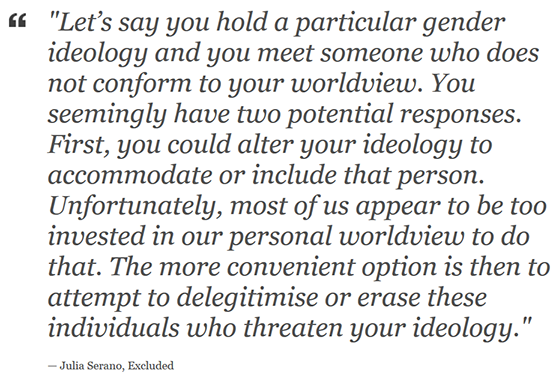 What if you’re trying to hold the same weird one-dimensional system in a way consistent with basic human decency? That is, you don’t want to do the Vogon thing and say Scott Aaronson’s misery is totally hilarious, but you also don’t want to acknowledge that it counts – because if it counted you’d have to admit that men have it bad in some ways, which means that the One Group That Can Ever Have Things Bad spot is taken by men, which means women don’t have it bad?
As best I can tell, the way with the fewest epicycles is to say “Yes, your pain technically exists, but it’s not structural oppression“, where structural oppression is the type of pain that fits neatly onto the one-dimensional line.
Laurie Penny is an extremely decent person, but like a shaman warding off misfortune with a ritual, she must dub Aaronson’s pain “not structural oppression” or else risk her own pain not counting, being somehow diminished.
I mean, I don’t think she thinks that’s what she’s doing. But I’m not sure why else it’s necessary to get so competitive about it.
Absent the one-dimensional view, it would be perfectly reasonable to say something like “You feel pain? I have felt pain before too. I’m sorry about your pain. It would be incredibly crass to try to quantify exactly how your pain compares to my pain and lord it over you if mine was worse. Instead I will try to help you with your pain, just as I hope that you will help me with mine.”
Given the one-dimensional view, any admission that other people suffer is a threat to the legitimacy of one’s own suffering. Horrible people will deny and actively mock the pain of others, but even decent people will only be able to accept the pain if they also mention in an aside that it doesn’t count as the correct sort of pain to matter in the moral calculus and certainly isn’t even in the same ballpark as their own.
But the one-dimensional view sucks. It is the culmination and perfection of the phenomenon I described in my post on social justice terminology, the abandonment of discourse about the world in favor of endless debate about who qualifies for certain highly loaded terms like “structural oppression”. And those terms end up as a sort of Orwellian Newspeak that makes it possible to dismiss entire categories of experience and decree by fiat who does and doesn’t matter.
Imagine a boot stamping on a human face forever, saying "I KNOW YOU FEEL UPSET RE STAMPING, BUT THAT'S DIFFERENT FROM STRUCTURAL OPPRESSION"
— Scott Alexander (@slatestarcodex) December 31, 2014
The boot acknowledged my pain! So compassionate!
*§*The suspect famously says “I didn’t kill him, officer! Also, he had it coming!”
In that spirit, I would like to propose that we shouldn’t make this debate about structural oppression, but even if we do this kind of minimization of male nerd suffering doesn’t stand.
I know there are a couple different definitions of what exactly structural oppression is, but however you define it, I feel like people who are at much higher risk of being bullied throughout school, are portrayed by the media as disgusting and ridiculous, have a much higher risk of mental disorders, and are constantly told by mainstream society that they’re ugly and defective kind of counts.
If nerdiness is defined as intelligence plus poor social skills, then it is at least as heritable as other things people are willing to count as structural oppression like homosexuality (heritability of social skills, heritability of IQ, heritability of homosexuality) If all nerds were born with blue dots on their heads, and the blue-dotters were bullied in school, cast negatively in the media, assumed to be as ravenous beasts hungry for innocent women, and denounced as “entitled” any time they overcame all this to become successful – would anybody deny that blue-dotters suffered from structural oppression? Wouldn’t the people who talked about how clearly blue-dotters are entitled dudebros in the tech industry be thought of the same way as someone who said Jews were greedy parasites in the banking industry?
Actually, let’s take this Jew thing and run with it. I am not the first person to notice that there are a lot of Jews in Silicon Valley. By maternal descent, at least Mark Zuckerberg, Sergey Brin, Larry Page, Michael Dell, Steve Ballmer, Larry Ellison, and Sheryl Sandberg.
Imagine how an anti-Semite might think about this. “Jews say they’re oppressed. But actually they’re all rich. Oppression disproved!”
In fact, he might he add exactly the same comment we see in the Statesman article: “This is why Silicon Valley is fucked up. Because it’s built and run by some of the most privileged people in the world who are convinced that they are among the least.”
But once again this only works when you have the dumb one-dimensional model of privilege. Some Jews are rich, therefore all Jews are rich, therefore all Jews are privileged, therefore no Jew could be oppressed in any way, therefore Jews are the oppressors.
And much the same is true of nerds. In fact, have you noticed actual nerds and actual Jews tend to be the same people? I’m Jewish. Scott Aaronson is Jewish. Laurie Penny, who declares her nerd-girl credentials, is Jewish. We’re discussing a blog called, of all things, Shtetl-Optimized. A minority that makes up 1% of the Anglosphere also makes up three of the three nerds in this conversation. Probability of this happening by chance is (*calculates*) exactly one in a million. Aside from Zuckerberg, Page, and all the other famous people, about 40% of top programmers are Jewish.
Judaism and nerdity are not exactly the same, but they sure live pretty close together.
And this is why it’s distressing to see the same things people have always said about Jews get applied to nerds. They’re this weird separate group with their own culture who don’t join in the reindeer games of normal society. They dress weird and talk weird. They’re conventionally unattractive and have too much facial hair. But worst of all, they have the chutzpah to do all that and also be successful. Having been excluded from all of the popular jobs, they end up in the unpopular but lucrative jobs, for which they get called greedy parasites in the Jews’ case, and “the most useless and deficient individuals in society” in the case of the feminist article on nerds I referenced earlier.
Propaganda against the Jews is described as follows:
Since Jews were ugly, they depended on reprehensible methods of sexual conquest. Non-violent means such as money were common, but also violence. Streicher specialized in stories and images alleging Jewish sexual violence. In a typical example, a girl cowers under the huge claw-like hand of a Jew, his evil silhouette in the background. The caption at the bottom of the page: “German girls! Keep away from Jews!” These images were particularly striking and consistent with the larger theme. Although Jews were too cowardly to engage in manly combat and too disgusting to be physically attractive to German women, they were eager to overpower and rape German women, thereby corrupting the Aryan racial stock.
I already know the same machine that turned Aaronson’s “I am 97% on board with feminism” into “I think all women should be my slaves” is focusing its baleful gaze on me. So let me specify what I am obviously not saying. I am not saying nerds have it “just as bad as Jews in WWII Germany” or any nonsense like that. I am not saying that prejudice against nerds is literally motivated by occult anti-Semitism, or accusing anyone of being anti-Semitic.
I am saying that whatever structural oppression means, it should be about structure. And the structure society uses to marginalize and belittle nerds is very similar to a multi-purpose structure society has used to belittle weird groups in the past with catastrophic results.
There is a well-known, dangerous form of oppression that works just fine when the group involved have the same skin color as the rest of society, the same sex as the rest of society, and in many cases are totally indistinguishable from the rest of society except to themselves. It works by taking a group of unattractive, socially excluded people, mocking them, accusing them of being out to violate women, then denying that there could possibly be any problem with these attacks because they include rich people who dominate a specific industry.
[EDIT 1/3: Penny’s same article was reprinted at New Republic, which I guess also realized it gotten a piece of the Hot New Nerd Entitlement Trend yet. Their title was “Nerd Entitlement Lets Men Ignore Racism And Sexism”, which is kind of weird, since Penny’s article doesn’t do anything close to argue for that. Also since surveys show nerd men are more likely to be concerned about racism and sexism than other men – see for example this survey where nerds are far more feminist than average, so much so that nerd men are more feminist than non-nerd women, and since Penny’s article makes nothing even resembling an argument for this position. Once again, this only makes sense if you assume a one-dimensional zero-sum model of privilege, where the fact that miserable male nerds are concentrating on their own desire for the release of death, instead of what women think they should be concentrating on, means they must be universally denying women can have problems.]
[EDIT 1/3, Part 2: New Republic has changed their title. You can still see it in the URL, though]
VII.
It gets worse.
What can I say? This is a strange and difficult age, one of fast-paced change and misunderstandings. Nerd culture is changing, technology is changing, and our frameworks for gender and power are changing – for the better. And the backlash to that change is painful as good, smart people try to rationalise their own failure to be better, to be cleverer, to see the other side for the human beings they are. Finding out that you’re not the Rebel Alliance, you’re actually part of the Empire and have been all along, is painful.
She links this last sentence to an article called Why Nerd Culture Must Die, which, I don’t know, kind of makes me a little more skeptical of all of her protestations that she’s exactly as much of a nerd as anyone else and likes nerds and is really working for nerds’ best interests. The article repeats that nerds think they’re “the Rebel Alliance” but actually are “the Empire”. Ha ha! Burn!
You may be wondering whether you missed the part of Star Wars where Darth Vader is so terrified of hurting or offending other people that he stops interacting with anybody and becomes suicidally depressed for years. Finally, Vader mentions this fact in the comments section of a blog about obscure Sith rituals. The brave Rebel Alliance springs into action and gets all of the Coruscant newspapers to publish articles on how Vader is entitled and needs to check his privilege.
I don’t know. Maybe this was one of those things that got taken out in the Special Edition?
(Han shot first!)
But there’s actually something even creepier going on here which may or may not be intentional.
The Transsexual Empire is a very famous book from the late 1970s subtitled “The Making Of The She-Male” in which feminist activist Janice Raymond argues that transsexuals, despite claiming to be persecuted, form an evil empire dedicated to the reinforcing of patriarchy. It contains delightful passages such as “All transsexuals rape women’s bodies by reducing the real female form to an artifact, appropriating this body for themselves”. The Transgender Studies Reader says that the book “did not invent anti-transsexual prejudice, but it did more to justify and perpetuate it than perhaps any other book ever written.” The response, written by a prominent transgender activist, was titled The Empire Strikes Back – an obvious reference to the Star Wars film published around that time.
So the question is – how come various feminists keep independently choosing the Empire as a metaphor for their enemies?
Once again the one-dimensional model of privilege rears its ugly head.
Transsexuals claimed to be suffering. This was a problem, because some of them were transwomen who had started with the male gender role. They had privilege! And they claimed to be suffering! The one-dimensional model of privilege lifts its eyebrows quizzically and emits a “…wha?”
The solution is to deny their suffering. Not only deny their suffering, but accuse them of being out to “rape women’s bodies”. Not only deny their suffering and accuse them of being rapists, but to insist that they are privileged – no, super-privileged – no, the most privileged – no, a giant all-powerful all-encompassing mass of privilege that controls everything in the world,.
So they became an Empire. How better to drive home the fact that they’re definitely powerful and oppressive and definitely definitely not suffering? Because if they were suffering, it would mean we weren’t.
There’s another word the radical feminists like to use about transsexuals. “It’s aggrieved entitlement,” Lierre Keith tells the New Yorker. “They are so angry that we will not see them as women.” The article continues to explain how “When trans women demand to be accepted as women they are simply exercising another form of male entitlement.”
And sigh, now here come the male nerds and say they’re suffering too, not as much as the transpeople but still a nonzero amount of pain! Is there no end to people who are not us, suffering in inconvenient ways? They say that when they feel haunted by scrupulosity, that shaming them all the time actually makes the problem worse! We need to establish that they’re privileged right away! So how better to rub in the concept of very privileged people than to draw in the old Empire analogy, right? Maybe try the “entitlement” claim again as well? Second time’s the charm!
But let’s be clear. There is a Star Wars metaphor to be made here.
Chancellor Palpatine is, by universal agreement, a great guy. According to Count Dooku, he “speaks honestly and champions the underprivileged” (direct quote from source
Like the Senate. When the Senate is not sure they want to hand over power to the Chancellor, he declares that they are corrupt and oppose democracy.
Or the Jedi. When the Jedi resist his rule, he declares that they are obsessed with “gain[ing] power” and “if they are not all destroyed, it will be civil war without end.”
Whenever he wants to steamroll over someone, Palpatine’s modus operandi is to convince everyone that they are scary oppressors. This isn’t just my personal interpretation. Indeed, in Order 66
“Beings believe what you tell them. They never check, they never ask, they never think…Tell them you can save them, and they will never ask—from what, from whom? Just say tyranny, oppression, vague bogeymen.”
If we’ve learned anything from the Star Wars prequels, it’s that Anakin Skywalker is unbearably annoying. But if we’ve learned two things from the Star Wars prequels, it’s that the easiest way to marginalize the legitimate concerns of anyone who stands in your way is to declare them oppressors loud enough to scare everyone who listens.
And if the people in the Star Wars universe had seen the Star Wars movies, I have no doubt whatsoever that Chancellor Palpatine would have discredited his opponents by saying they were the Empire.
(seriously, you wanted to throw the gauntlet down to lonely male nerds, and the turf you chose was Star Wars metaphors? HOW COULD THAT POSSIBLY SEEM LIKE A GOOD IDEA?)
VIII.
Unlike Aaronson, I was also female, so when I tried to pull myself out of that hell into a life of the mind, I found sexism standing in my way. I am still punished every day by men who believe that I do not deserve my work as a writer and scholar. Some escape it’s turned out to be.
Science is a way that shy, nerdy men pull themselves out of the horror of their teenage years. That is true. That is so. But shy, nerdy women have to try to pull themselves out of that same horror into a world that hates, fears and resents them because they are women
Scott, imagine what it’s like to have all the problems you had and then putting up with structural misogyny on top of that.
Ms. Penny believes that, as a woman, she’s been unfairly excluded from the life of the mind and, indeed, from every pursuit she might enjoy or use as an escape.
There is something to be discussed here, but I am having trouble isolating Ms. Penny’s exact claim.
“Unfairly excluded from the life of the mind” might suggest she didn’t have the same opportunities as men to participate in higher education, but in fact women are now 33% more likely than men to earn college degrees and women get higher grades in college than men do. They also get well above half of all master’s degrees, and just a slice over half of all Ph.Ds (and rising). Their likelihood of becoming professors is nicely predicted by the percent of degrees they earn at a couple decade interval. The articles about the world of higher education now all have titles like Missing Men or Why Are Men Falling Behind.
Industry isn’t a good example here either. Women in her demographic group – twenty-something and childless – out-earn their male counterparts by almost ten cents on the dollar.
And she’s probably not talking about science, since women earn 55% of science degrees nowadays. They are somewhat overrepresented even in some “hard” sciences like biology, but overwhelmingly so in the social sciences. Over seventy five percent of psychology majors are female – a disproportionate which blows out of the water the comparatively miniscule 60-40 disproportion favoring men in mathematics.
(Hi! Male psychology major here, can confirm!)
When Penny says she as a woman is being pushed down and excluded from every opportunity in academic life, she means that women in a very small subset of subjects centered around computer science and engineering face a gender imbalance about as bad as men do in another collection of subjects such as psychology and education.
Penny attacks nerds for believing that “holding men to account for the lack of representation of women in STEM areas…is somehow unfair.” Fine. I hold her to account for the even higher imbalance in favor of women in psychology and education. Once she accepts responsibility for that, I’ll accept responsibility for hers. That sounds extremely fair.
(“But that’s because of patriarchy!” READ SECTION V.)
I propose an alternate explanation to both dilemmas.
By late high school, the gap between men and women in math and programming is already as large as it will ever be. Yes, it’s true that only 20 – 23% of tech workers are women. But less than twenty percent of high school students who choose to the AP Computer Science test are women.
Nothing that happens between twelfth grade and death decreases the percent of women interested in computer science one whit.
I have no hard numbers on anything before high school, but from anecdotal evidence I know very very many young men who were programming BASIC on their dad’s old computer in elementary school, and only a tiny handful of young women who were doing the same.
I don’t want to get into a drawn out inborn-ability versus acculutration fight here. I want to say that I want to say that whether we attribute this to inborn ability or to acculturation, the entire gender gap has been determined in high school if not before. If anything, women actually gain a few percentage points as they enter Silicon Valley.
What the heck do high schoolers know about whether Silicon Valley culture is sexist or not? Even if you admit that all the online articles talking about this are being read by fourteen year olds in between Harry Potter and Twilight, these articles are a very new phenomenon and my stats are older than they are. Are you saying the is because of a high level of penetration of rumors about “toxic brogrammers” into the world of the average 11th grader?
The entire case for Silicon Valley misogyny driving women out of tech is a giant post hoc ergo propter hoc.
What’s worse, I have never heard any feminist give this case in anything like a principled way. The explanation is usually just something like of course men would use their privilege to guard a well-paying and socially prestigious field like programming from women, men have always guarded their privileges, they’ve never given anything up to women without a fight, etc.
My own field is medicine. More than half of medical students are female. In two years, more than half of doctors in the UK will be female, and the US is close behind.
Medicine is better-paying and more prestigious than programming. It’s also terrible. Medicine is full of extremely abrasive personalities. Medicine has long work hours. Medicine will laugh at you hysterically if you say you want to balance work and family life.
But women can’t get into medicine fast enough. Every so often medical journals and the popular news run scare stories about how there are so many women in medicine now that if they take off time to raise kids at their accustomed rates we’re suddenly going to find ourselves pretty much doctorless.
So any explanation of the low number of women in Silicon Valley has to equally well explain their comparatively high numbers in medicine.
Given all this, it’s really easy for me to see why it’s tempting to blame nerds. Look at these low-status people. It’s their fault. We already dislike them, now we have an even better reason to dislike them that nicely wraps up an otherwise embarassing mystery. They’re clearly repelling women with their rapey creepishness. It doesn’t hurt that occasional high profile stories of sexual harassment come out of Silicon Valley aren’t hard to find and bring viral.
(no one ever asks whether there are an equally high number of stories of sexual harassment in medicine – or law, or any other field – that no one had a reason to publicize. When I was in medical school, there was an extremely creepy incident of sexual harassment/borderline attempted rape involving a female medical student and male doctor at an outlying hospital where I worked. Nobody put it on the front page of Gawker, because the doctor involved wasn’t a nerd and no one feels any particular need to tar all doctors as sexist.)
But again, you really can’t blame this one on Silicon Valley nerds, unless they are breaking into high schools and harassing the women there. And possibly breaking into grade schools, demanding the young boys start tinkering with BASIC. Time for a better theory.
A look at percent female physicians by subspecialty is instructive. The specialty with the most women is pediatrics, followed by child psychiatry, followed by obstetrics, followed by – you get the picture. The specialties with the least women are the various surgeries – the ones where your patient is immobilized, anaesthetized, opened up, and turned into a not-quite-color-coded collection of tubes and wires to poke and prod at – the ones that bear more than a passing resemblance to engineering.
(surgeons are the jockiest jocks ever to jock, so you can’t blame us for this one)
It seems really obvious to me that women – in high schools and everywhere else – have a statistical predilection to like working with people (especially children) and to dislike working with abstract technical poking and prodding. This is a bias clearly inculcated well before SATs and AP exams, one that affects medics and programmers alike.
It’s a bias that probably has both cultural and biological origins. The cultural origins are far too varied to enumerate. Many people very justly bring up the issue of how our society genders toys, with parents getting very angry when girls play with stereotypically male toys and vice versa. The classic example is of course the talking Barbie who would famously say “Math is hard! Let’s go shopping!”
On the other hand, I also think people who neglect biological causes are doing the issue a disservice. Did you know that young monkeys express pretty much exactly the same gendered toy preferences as human children? Rhesus monkeys, vervet monkeys, pretty much whatever species of monkeys you try it on, the male monkeys enjoy wheeled toys more and the female monkeys plush toys more. The word reviewers use to describe the magnitude of the result is “overwhelming”. When intersex children are raised as other than their biological gender, their toy preference and behavior are consistently that associated with their biological gender and not the gender they are being raised as, even when they themselves are unaware their biological gender is different. This occurs even when parents reinforce them more for playing with their gender-being-raised-as toys. You can even successfully correlate the degree of this with the precise amount of androgen they get in the womb, and if you experimentally manipulate the amount of hormones monkeys receive in the womb, their gendered play will change accordingly. 2D:4D ratio, a level of how much testosterone is released during a crucial developmental period, accurately predicts scores both on a UK test of mathematical ability at age seven and the SATs in high school.
The end result of all this is probably our old friend gene-culture interaction, where certain small innate differences become ossified into social roles that then magnify the differences immensely. As a result, high school girls are only a fifth as likely to be interested in computer science as high school boys, and sure enough women are only a fifth as well represented in Silicon Valley as men.
All of this information is accessible for free to anyone who spends ten minutes doing a basic Google search. But instead we have to keep hearing how nerds are gross and disgusting and entitled and should feel constant shame for how they bully and harass the poor female programmers out of every industry they participate in. Penny blames nerds for not “holding men to account for the lack of representation of women in STEM areas” but SERIOUSLY WE DIDN’T DO IT.
(except insofar as we helped acculturate kids. But that’s hardly a uniquely male pasttime.)
(before you bring up that one paper that showed research leaders advantaged male over female researchers, keep in mind that first of all it explains only a small portion of the discrepancy, and second of all the female research leaders showed the bias even worse than the male ones. Yet Penny frames her question as “holding men to account”. This is that motte-and-bailey thing with patriarchy again.)
Do you realize how unpleasant it is to be constantly blamed all the time for something we didn’t do, and have that be used to justify every form of insult and discrimination and accusation against us? The oldest pattern in human history is “Here’s a problem. And here’s a bunch of people who are different than us. Let’s blame it on them!”
There’s enough information out there to prove that creepy nerds are not the problem with female representation in STEM. Then again, there’s also enough information out there to prove that gay people don’t cause earthquakes. People will believe what they want to believe.
*§*On the other hand, I’ve said above that I don’t like completely ignoring the accounts of thousands of people who say there’s a problem. Although my female friends in computer science keep insisting they’ve never encountered sexism there, many many others say they have.
But let’s keep our causal arrows pointing the right direction. Any space with a four-to-one male:female ratio is going to end up with some pretty desperate people and a whole lot of unwanted attention. Add into this mix the fact that nerds usually have poor social skills (explaining exactly why would take a literature review to put that last one to shame, but hopefully everyone can agree this is true), and you get people who are pretty sure they are supposed to do something but have no idea what. Err to one side and you get the overly-chivalrous people saying m’lady because it pattern matches to the most courtly and least sexual way of presenting themselves they can think of. Err to the other, and you get people hollowly imitating the behavior they see in famous seducers and playboys, which when done without the very finely-tuned social graces and body-language-reading-ability of famous seducers and playboys is pretty much just “being extremely creepy”.
But once you accept this model, it starts to look like feminists and I are trying to solve the same problem.
The problem is that nerds are scared and confused and feel lonely and have no idea how to approach women. From this root problem blossoms both Aaronson’s problem – that sometimes all you can do is go to a psychiatrist and ask to be castrated – and Penny’s problem – that other times people go read pickup artistry books that promise to tell them how the secret is “negging” people.
But Aaronson’s solution to the problem is to talk about it. And feminism’s solution to the problem is to swarm anyone who talks about it, beat them into submission, and tell them, in the words of Marcotte, that they are “yalping entitlement combined with an aggressive unwillingness to accept that women are human beings just like men”
IX.
Every article about male nerds calls us “entitled”.
I’m pretty sure they don’t mean financially, since nerds for example give disproportionately more to charity than other groups (see: Bill Gates, the joke in the effective altruist movement that it contains “all kinds of people – mathematicians, economists, philosophers, and computer scientists”).
And I’m pretty sure they don’t mean politically, since nerds are far more likely to support wealth redistribution than the general population (compare political alignment here to your choice of nationwide poll).
And I’m pretty sure they don’t mean psychologically. In psychology, entitlement as a construct is usually blended with narcissism. Predictors of narcissism include high emotional intelligence, high social skills but (uniquely among Dark Triad traits) not high nonverbal (ie mathematical) intelligence, and high extraversion. Another interesting fact about narcissists is that they tend to have more sexual partners than non-narcissists. Jonason describes the research on narcissism and sex by saying that “Narcissists find it easy to start new relationships but are less committed to and interested in staying in existing relationships.” I feel like even feminists should be able to agree that “extraverted people with excellent social skills but no particular mathematical aptitude who find it easy to start new relationships” is not a perfect match for nerds here.
So I don’t think these articles are talking about entitlement full stop. I guess they’re using this to point solely at sexual entitlement. But even this seems to require further clarification.
Do they mean nerds hold sexist attitudes? The research (1, 2, 3, 4) shows that sexist attitudes are best predicted by low levels of education, high levels of religious belief, and (whites only) low neuroticism. Once again, I don’t feel it should be controversial to say that “very religious people who drop out of school early and are psychologically completely healthy” is not how most people would describe nerds. Besides, in a survey I did of 1500 people on an incredibly nerdy forum last year, the average was extremely feminist, so much so that the average nerdy man was more feminist than the average non-nerdy woman.
Do they mean nerds are more likely to rape people? There is an appropriate caveat here that it is difficult-to-impossible to profile rapists – but if people took that caveat seriously then you couldn’t profile nerds as rapists either. Since we’re already talking about profiling, let’s go all the way and find that the best research about rapists (source: David Lisak) does find various characteristics of undetected campus rapists (ie primarily date rapists who get away with it, we’re not just talking about scary felons with knives here as a red herring). Some of these are purely psychological (“they’re sexist and don’t like women”). But the rest include: rapists are more sexually active and “engage in consensual and coercive sex far more often than is typical for men of their age group”. They are members of “sexually violent subcultures” including “fraternities and gangs”. They are “hypermasculine” and “strive always to behave in rigidly and stereotypically masculine ways” They are heavy drinkers, often using alcohol to release either their own inhibitions or those of their victims.
Once again, I feel like “hypermasculine frat boys and gangsters who party too hard and have a large number of partners” is a really poor description of nerds.
When people talk about nerds feeling “sexually entitled”, it’s never about any of these things. It’s always the same: A male nerd has dared to express that he is sad about being alone and miserable. Then they round this off to “therefore he believes everyone else owes him sex because he is so great” in precisely the way Amanda Marcotte does explicitly and Penny allows to lie beneath the surface.
Once again, Scott Aaronson’s entire problem was that he was so unwilling to hurt women even unintentionally, and so unclear about what the rules were for hurting women, that he erred on the side of super-ultra-caution and tried to force himself never to have any sexual interest in women at all even to the point of trying to get himself castrated. If entitlement means “I don’t care about women’s feelings, I just care about my own need for sex”, Aaronson is the perfect one hundred eighty degree opposite of entitlement. He is just about the most unentitled (untitled?) person imaginable.
Yet Aaronson is the example upon which these columnists have decided their case for “nerd entitlement” must rise and fall. You have better examples? Then why didn’t you use them?
I’ve already admitted that when a girl asked me out in middle school, I ran away terrified because I figured nobody could actually like me and it was obviously some kind of nasty trick. If entitlement means “believing you deserve all the sex”, then teenage-me also sounds pretty untitled.
Yet I, too, get to forever read articles about how entitled I am.
I’m not making some kind of #NotAllNerds statement here, any more than someone who disagrees with the claim “elephants are tiny” is claiming #NotAllElephants
A better word for this untitlement is, perhaps, scrupulosity, where you believe you are uniquely terrible and deserve nothing. Scrupulosity is often linked to obsessive compulsive disorder, which the recent survey suggests nerds have at higher rates than the general population and which is known to be more common in high-IQ people. When I hear my utilitarian friends say things like “I have money and people starving in Africa don’t have money, therefore I am morally obligated to give half of my money to people starving in Africa or else their starvation is my fault” and then actually go and do that – and trust me, these people are always nerds – then as often as not it’s scrupulosity at work.
When you tell a highly-untitled, high-scrupulosity person that they are entitled, it goes about as well as telling an anorexic person that they are fat.
If your excuse is going to be “okay, some nerds are overly scrupulous, but others are entitled”, how come that wasn’t your argument before? And how come, with laser-like focus, you only pick on the scrupulous ones? How come it’s 2015 and we still can’t agree that it’s not okay to take a group who’s already being bullied and harassed, stereotype it based on the characteristics of its worst members, and then write sweeping articles declaring that the entire group is like that?
X.
When Laurie Penny writes to women, she says:
What I most wanted to say, to all the messed-up teenagers and angry adults out there, is that the fight for your survival is political. The fight to own your emotions, your rage and pain and lust and fear, all those unspeakable secrets that we do not share because we worry that we will be hurt or shunned, is deeply political.
When Laurie Penny writes to men, she says:
Most of all, we’re going to have to make like Princess Elsa and let it go – all that resentment. All that rage and entitlement and hurt.
Clearly this second suggestion contains a non-standard use of the word “we”.
When women feel like they’re not allowed to “own their emotions” like “lust”, or have “secrets that they do not share because they worry that they will be hurt or shunned”, then it is “deeply political” and they have to “fight about it.”
When men make the same complaint, they are encouraged to “let go” of their “resentment” and “entitlement”.
The same worries, deep and secret fears, that are the core and driving heat of Penny’s feminism when they happen to women get called “entitlement” when they happen in men and need to be “let go”. You’re not allowed to complain about them. You’re not even allowed to ask the people hurting you to stop – then you’re super entitled. You shut up and get on with your life.
But it’s actually much worse than that. If you remember only one thing from this entire post, remember that Anakin Skywalker is unbearably annoying remember this:
The past is over. I do not hold, and have never held, any ill will toward the women who rejected me. Some of them continue to be my close friends. Some of them I’ve talked to about this Scott Aaronson thing, and even they agree with me on it. Nor did Aaronson mention any ill will to anyone who rejected him. Talking about how nerds should let go of our past resentment to our crushes is a giant red herring.
What this entire discussion is about is our very present resentment toward the (some) feminists who continue to perpetuate the stereotypes that hurt us then, continue to attack us now whenever we talk about the experience or ask them to stop, and continue to come up with rationalizations for why they don’t have to stop. This isn’t about little Caitlin who wouldn’t return my eye contact in seventh grade, this is about Amanda Marcotte, Jezebel, Gawker, and an entire system that gets its jollies by mocking us and trying to twist the knife.
The only reason little Caitlin is being brought up is so that feminists who don’t want to stop twisting can sidestep any criticism by pretending our argument is entirely how a seventh-grader shouldn’t have control of her own romantic decisions.
@#!$ that. Little Caitlin can do what she wants with her life. But dehumanizing and perpetrating stereotypes about a whole group of people who already have it pretty bad is not okay.
XI.
I already know that there are people reading this planning to write responses with titles like “Entitled Blogger Says All Women Exist For His Personal Sexual Pleasure, Also Men Are More Oppressed Than Women, Also Nerds Are More Oppressed Than WWII Era Jews”. And this post is way too long for most people who read those responses to get their misconceptions corrected. So before I close, let me give a brief summary of what I am trying to say:
1. There are a lot of really nasty stereotypes perpetuated about nerds, especially regarding how they are monsters, nobody can love them, and they are too disgusting to have relationships the same way other people do.
2. Although both men and women suffer from these stereotypes, men really do have a harder time getting relationships, and the experience is not the same.
3. Many of the people suffering from these stereotypes are in agreement that it is often self-identified feminists who push them most ardently, and that a small but vocal contingent of feminists seem to take special delight in making nerds’ lives worse.
4. You cannot define this problem away with the word “patriarchy”.
5. You cannot define this problem away by saying that because Mark Zuckerberg is a billionnaire, nerds are privileged, so they already have it too good. The Jews are a classic example of a group that were both economically advantaged in a particular industry, but also faced unfair stereotypes.
6. Whether women also have problems, and whether their problems are even worse, is not the point under discussion and is not relevant. Women can have a bunch of problems, but that doesn’t mean it is okay for any feminists to shame and bully nerds.
7. Nerds are not uniquely evil, they are not especially engaged in oppressing women, and they are not driving women out of Silicon Valley. Even if they were, “whenever they choose to open up about their private suffering” is not the time to talk about these things.
8. “Entitlement” is a uniquely bizarre insult to level at nerds given that by most of the term’s usual definitions nerds are some of the most untitled people there are.
9. The feminist problem of nerds being desperate and not having any social skills (and therefore being creeps to women) is the same as the nerd problem of nerds being desperate and not having any social skills (and therefore having to live their life desperate and without social skills). Denying the problem and yelling at nerds who talk about it doesn’t help either group.
10. The nerd complaint on this issue is not “high school girls rejected us in the past when we were lonely and desperate,” it is “some feminists are shaming us about our loneliness and desperation in the past and present and openly discussing how they plan to do so in the future.” Nobody with principles is angry at the girls who rejected them in the past and this is a giant red herring. If you don’t believe any feminists are shaming anyone, then say so; don’t make it about little Caitlin in seventh-grade.
If you want to debate or fisk this article, I would recommend using these paragraphs as starting points instead of whatever bizarre perversions of my words the brain of the worst person reading this can dream up.
[EDIT 1/15: Okay, it looks like the talking point people chose to go with was “he made a 1984 joke, therefore the thesis of the essay is that all men are oppressed by all women exactly as badly as people are oppressed in 1984.” As usual, I was insufficiently pessimistic.]
XII.
Penny ends:
We bring our broken hearts and blue balls to the table when we talk gender politics, especially if we are straight folks. Consent and the boundaries of consent – desire and what we’re allowed to speak of desire – we’re going to have to get better, braver and more honest, we’re going to have to undo decades of toxic socialisation and learn to speak to each other as human beings in double quick time.
[…]
The road ahead will be long. I believe in you. I believe in all of us. Nerds are brilliant. We are great at learning stuff. We can do anything we put our minds to, although I suspect this thing, this refusing to let the trauma of nerdolescence create more violence, this will be hardest of all.
I see a vision here of everybody, nerdy men, nerdy women, feminists, the media, whoever – cooperating to solve our mutual problems and treat each other with respect. Of course I am on board with this vision. As Scott Aaronson would put it, I am 97% on board. What keeps me from being 100% on board right now is the feeling that the other side still doesn’t get it.
First of all, a whole lot of other side is not Laurie Penny. They are the people gleefully mocking our pain and telling us we deserve it. But even the good people are worrisome enough.
They admit that nerdy men, lesbians, bisexuals, etc may be in pain, but they deny categorically any possible role of feminist shaming culture in causing that pain and want to take any self-reflection on their part off of the table of potential compromise.
They admit that our pain technically exists, but they are unable to acknowledge it without adding “…but by the way, your pain can’t possibly ever be as bad as our pain” or “your pain doesn’t qualify for this ontologically distinct category of pain which is much more important.”
They continue to think it is appropriate to respond to any complaint or expression of suffering on our part with accusations of “entitlement”, comparisons to Darth Vader, and empirically-contradicted slanders about how our mere presence drives women away from everything we love.
Once I see anyone, anywhere, publish an article that not only recognizes our pain, but doesn’t derail it into an explanation of why we’re definitely still terrible and there is no need whatsoever for them to change, then I will be more optimistic that progress is at hand.
XIII.
Oh frick.
And on that note I shall return to what I was doing before I read this post, which was drinking sweet tea and weeping about how boys don’t seem to want to kiss short-haired lady nerds, and trying not to blame the whole world for my broken heart, which is becoming more complex and interesting in the healing but still stings like a boiling ball of papercuts. I’ll let you know how that goes.
Having so much fun picking this article apart, and then this 🙁
Look. I mean what I say about how I don’t believe in zero-sum games. The reality of Prof. Aaronson’s problem does not for one second diminish the reality of Ms. Penny’s sadness as well.
So here is my offer to Ms. Penny. If she accepts and is in some kind of heavily nerd-populated city (NYC? SF?) I will use my connections in the nerd community to get her ten dates within ten days with intelligent, kind, respectful nerdy men of whom she approves. If she is in some less populated place, I will get her some lesser but still non-zero number of dates (unless she’s in Greenland or somewhere, in which case she’s on her own).
If I can’t do that, she may feel welcome to publically mock me and tell me that I was overconfident about how many people are, in fact, extremely willing to kiss short-haired lady nerds.
The rest of this article was serious, but this is extra serious. Let me know.
[EDIT: Comments are now closed, because this got linked on Instapundit and I know from experience that bad things happen if you leave the comments open after that point. Also, my comment software starts acting weird after like a thousand. If you must comment on this further, go bother Ozy on their open thread]. If you’re named in this article and you want to rebut it or reply, email me and I’ll include it somewhere.
