Progesterone Megadoses Might Be A Cheap Zulresso Substitute
Scott Alexander proposes using high-dose oral progesterone as a potential low-cost alternative to Zulresso for treating postpartum depression, based on pharmacological research.
Earlier this week we talked about Zulresso, a new medication for post-partum depression. It works well, but it can only be administered at a few special hospitals, and costs $35,000 per treatment.
But Zulresso is a natural metabolite of the female hormone progesterone. What’s stopping people from taking progesterone, waiting for their bodies to metabolize it into Zulresso, and saving $35,000 and a hospital stay?
As far as I can tell, nothing.
Andreen et al give some people a dose of 20 mg progesterone, then measure allopregnanolone levels. They find that the progesterone gets converted into allopregnanolone, with a max plasma concentration of about 8 nmol/L. This is about a fifth of allopregnanolone levels during pregnancy, which a course of Zulresso is trying to match. So in theory (and assuming simple pharmacokinetics) a dose of 100 mg progesterone ought to give the same peak level of allopregnanolone as a Zulresso infusion.
The only people I can find who take this to its logical conclusion are Barak & Glue. They do the same calculation as above much more rigorously, and suggest that the following progesterone regimen would correspond to the typical Zulresso infusion:
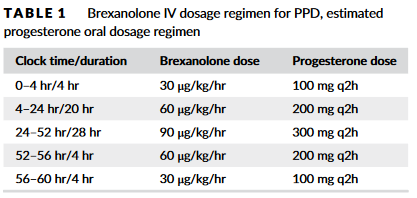
This would require a total of 7000 mg progesterone over ~3 days. 7000 mg of progesterone costs $10.94 in the United States. This would be quite a lot of oral progesterone by normal standards - there’d be a part in the middle where you take 42 pills over a 24 hour period - but I think it would end up simulating the natural hormone level of pregnancy. If pregnancy doesn’t have a side effect, I don’t think this regimen should have that side effect either.
The main obstacle here seems to be that a q2 hour dosing schedule doesn’t leave a lot of time for sleep. But given that these are postpartum women, they’re probably getting up every two hours in the middle of the night anyway; I’m not sure having to take the progesterone makes it any worse. In the unlikely chance that they do want more than two hours of sleep, I bet there are clever things you can do with extended release progesterone formulations.
Barak & Glue weren’t able to test their regimen, but the logic behind it seems pretty strong. And here’s a comment by a compounding pharmacist, saying “we've been giving progesterone for like 4 decades at the compounding pharmacy where I work, and we've been talking about its metabolism to allopregnanolone for about 20 years.”
If this worked, it would let the health system replace a $35,000 drug with a $10 one - or let patients who could never afford the $35,000 drug get the treatment at all. I’m not optimistic; parts of the FDA approval system, the insurance authorization process, and doctors’ prescribing practices all push against ideas like this. But it’s not impossible, and I hope some researcher will eventually try it.