Can We Link Perception And Cognition?
Scott Alexander explores potential links between perception of optical illusions and cognitive styles, proposing further research to investigate these connections.
Last month I talked a little bit about the Hollow Mask Illusion as a clue to the Bayesian operations going on “below the hood” in the brain. Today I want to go a little bit deeper into what the SSC survey results can tell us here. This is a list of a bunch of different variables I tested in the survey, and the percent of each group who saw the Mask Illusion and Dancer Illusion as ambiguous. “RR” is relative risk:
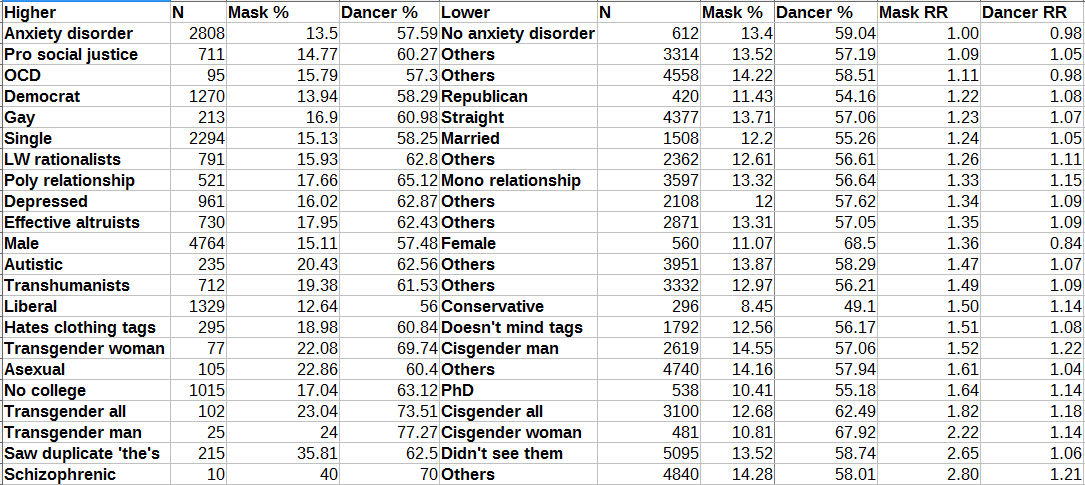 I don’t have p-values listed here, but almost all the Hollow Mask results, and a few of the Spinning Dancer results, were significant at p ≤ 0.01. And beyond the individual results, a few things jump out of the data in general. The Hollow Mask results and Spinning Dancer results are always in the same direction. And it always seems to be the weirder group who see more ambiguity in the illusion. Yes, schizophrenics see more ambiguity than non-schizophrenics. But transhumanists also see more ambiguity than non-transhumanists. Polyamorous people see more than monogamous people, gay people see more than straight people, EAs see more than non-EAs, et cetera. Where there’s no clear weirder/less-weird dichotomy, it seems like it’s the lower-functioning group that has more ambiguity. High school dropouts rather than PhDs. Single people rather than married people.
So there seems to be a picture where high rates of perceptual ambiguity are linked to being weirder and (sometimes, in a very weak statistical way) lower-functioning.
But why stop there? The dream is to connect this to some sort of intuitively-meaningful cognitive variable.
For a sense of “intuitively meaningful cognitive variable”, consider something like those four-letter things you get on the Myers-Briggs test. Go ahead and interject that Myers-Briggs is unscientific, and no better than astrology, and inferior to the Five Factor Model in every way. But everyone who says that always ends up being INTJ/INTP. And a survey found that SSC readers are about ten times more likely to be INTJ/INTP than the general population, p ≤ 0.001. Without necessarily claiming that the underlying classification cleaves reality at the joints, or even that it gives you more information than you put into the personality test that generates it, differences in cognitive styles seems real. I don’t know how fundamental they are – it could just be something as silly as a freshman philosophy professor who encouraged you to think logically or something – but they seem real.
And they seems different than the variables on the Big Five. The Big Five measures personality. Myers-Briggs claims – maybe wrongly, but at least it claims – to measure how you reason about things. Maybe everyone’s had the experience of meeting someone who seems very smart, but who just reasons in a very different way than they do.
And if the Bayesian brain hypothesis is right, and perception and reason really do draw on the same fundamental processes, then I wonder if we could isolate some differences in reasoning by measuring differences in perception. Could perception of certain optical illusions predict responses to certain cognitive biases? Could that go on to predict things like whether people like analytic or continental philosophy, whether they’re early-adopters or traditionalists, whether they think people are basically good or basically evil?
I know this is an overly ambitious research program. But remember: the studies looking for the genetic underpinning of political opinions usually implicate NMDA receptors, the same receptors most likely involved in the Hollow Mask. And there was a small but highly significant correlation between Mask perception and political opinion on the survey. I agree this is crazy, but I don’t want to say it’s impossible just yet.
On the the next survey, I want to include a whole battery of illusions, including multiple examples of the same illusion asked in different ways, and different illusions that seem to be measuring the same thing. For an example of the latter, take the “saw duplicate thes” item on the table above. This was a question asking if people had noticed various duplications of the word “the” I had put in the survey (like the one in the second and third words of this paragraph). People who noticed the duplicates were more than twice as likely to see ambiguity in the Hollow Mask as others, the highest result other than schizophrenia itself. This confirms my hypothesis that there’s some underlying similarity between these two illusions. If I can get enough of these, then I can eliminate noise and get a better idea of the underlying mental process that might be generating all of these.
With luck, I might end up with a couple of different factors that predict illusion perception. Then I would want to see if those factors also predict performance on reasoning problems (like cognitive biases) and on high-level beliefs (like liberal versus conservative).
The big question is whether some non-neurological factor influences perception of illusions – like maybe just trying really hard to see them. I’m not sure how to adjust for that, except to say that the pattern here doesn’t really look like that. The Dancer illusion was the one most susceptible to increased effort, and it got the weakest results. On a quick check, it doesn’t look like this is all due to something obvious like gender or age. But maybe there’s still some confounding factor that I’ve missed.