Change Minds Or Drive Turnout?
Scott examines claims that political parties should focus on base turnout rather than appealing to moderates, finding evidence that extreme candidates decrease turnout and swing voters matter.
I.
Current Affairs: The Democratic Party Just Admitted It Doesn’t Stand For Anything. Overall it makes some good points, but one passage caught my eye:
[Democrats believe that if you moderate your platform and swing toward the center] you might lose a few hardcore lefties, but you’ll more than make up for it in the number of Reaganites you peel away from the other side. (Or, as Chuck Schumer put it, “For every blue-collar Democrat we lose in western Pennsylvania, we will pick up two moderate Republicans in the suburbs in Philadelphia.”)
But this philosophy is a dead end. For one thing, it doesn’t work. Unless you have Bill Clinton’s special charismatic magic, what actually happens is that progressive voters just stay home, disgusted at the failure of both parties to actually try to improve the country. And the mythical “moderate Republicans” never seem to show up. (This is because there are no actual moderate Republicans.)
This has been a staple of recent leftist thought. Another example from Daily Kos (via the paper below):
The key data is this, and it’s important to re-emphasize if only to shut up the useless, overpaid political consultants who idiotically babble about “moving to the center” or “compromising with the other side”…What matters is turning out our voters. That’s it. The Democrats win when we fire up and turn out our base.
This sounds like a win-win situation. We can stick to our principles, and that actually makes us more electable. Big if true. But is it?
II.
First: do more extreme views increase base turnout? This is the subject of Hall & Thompson (2017). They examine 1658 House races from 2006 to 2012 and start by noticing that the more distant a candidate from the median voter in their district, the fewer votes they get and the lower their party’s share of turnout in the general election (ie the various other races that go on at the same time). This suggests that not only are the voters who do turn out less likely to vote for the extremist, but that many of their voters are staying home (or many of their opponents’ voters have been galvanized to show up).
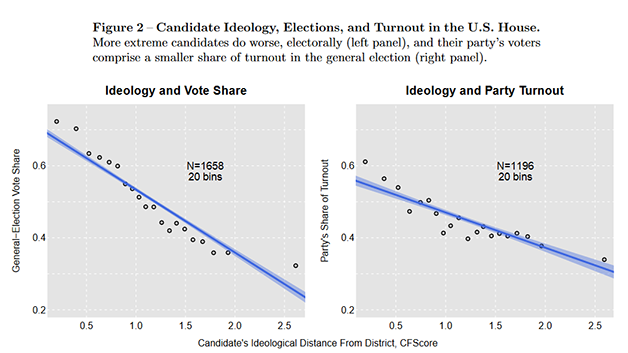 These raw results could be driven by exogenous factors. For example, maybe in swing states, parties nominate more centrist candidates (to get a broader appeal) and have higher turnout (because people’s votes actually matter). To eliminate this possibility, the researchers try a regression discontinuity design – ie they compare districts where extremists won the primary by 0.1% to districts where extremists lost the primary by 0.1%. These sorts of tiny margins are likely to be pretty random, so it’s almost like an experimental trial of what happens when you randomly vary candidate extremism.
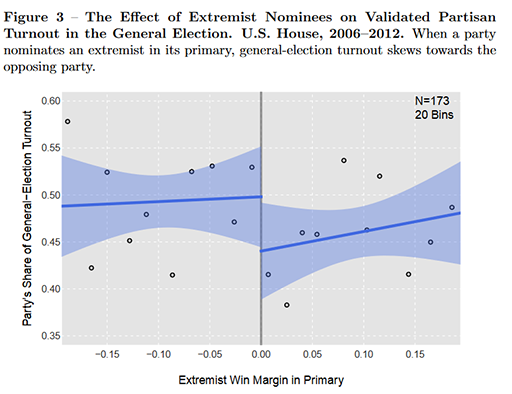 This better-controlled data set finds the same thing. The more extreme a candidate, the lower their party’s share of the turnout.
This actually makes a lot of sense – a lot of my normally non-voting friends turned out last November because they hated Trump so much, and a lot of #NeverTrump Republicans, unwilling to hold their nose and vote Hillary, just stayed home.
Hall and Thomspon conclude:
This paper engages with a longstanding debate over the relative strengths of extreme legislative candidates, thought to boost turnout among their party’s base, and moderate candidates thought to attract hypothetical moderate swing voters. Using several different empirical strategies, we have found consistent evidence that extremist nominees do poorly in general elections in large part because they skew turnout in the general election away from their own party and in favor of the opposing party.
They crunch a few more numbers and conclude that effects on turnout might be the entire reason why extremist candidates do worse. That is, there is no remaining effect from swing voters who switch from their own party to the other party. Turnout is the only thing that matters:
The results suggest that much of moderate candidates’ success may actually be due to the turnout of partisan voters, rather than to swing voters who switch sides. In fact, our regression discontinuity estimates are consistent with the possibility that the entire vote-share penalty to extremist nominees is the result of changes in partisan turnout. Seen in this light, the results are more consistent with the behavioral literature’s focus on turnout than they are with the institutional literature’s theoretical focus on swing voters. As such, we see this paper as helping to link the behavioral and institutional literatures together, suggesting that moderate candidates do possess an electoral advantage, but that this advantage may depend heavily on turnout-based mechanisms.
So Thompson and Hall disagree with the theory that a less compromising, more robustly leftist Democratic Party would get more votes. But they tentatively agree with Current Affairs’ claim that “moderate Republicans” are a myth and nobody ever switches sides.
III.
Second: Is base turnout really the only thing that matters?
I’m reluctant to disagree with real political scientists like Hall and Thompson, but I’m a little more optimistic about whether people can change their minds.
There’s little data on vote-switching, and the only directly relevant information I could find was this CNN exit poll from 2008:
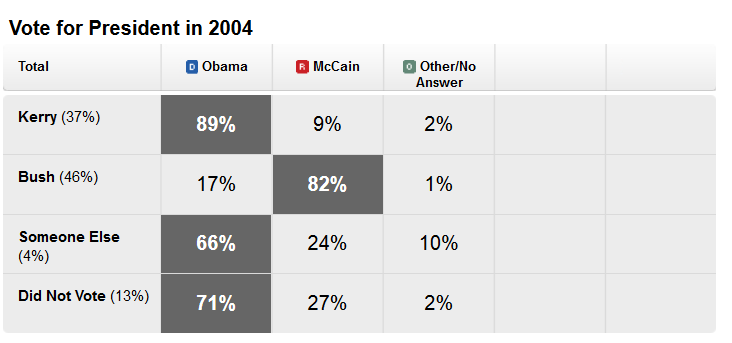 Of people who voted Democrat for President in 2004, 9% went Republican in 2008. Of people who voted Republican in 2004, a full 17% went Democrat in 2008. Some analysts of this information caution us that people are bad at remembering their votes so some of this may be wrong. But I feel like this story also doesn’t fit well with with unchanging-eternal-partisanship narrative – if you’ve voted straight Republican for the last ten elections and loathe all Democrats with a burning fury, you’re not going to just forgot whether you voted Bush or Kerry in ’04.
Rasmussen doesn’t have a real exit poll, but they put a couple of different sources together to guess about how many people switched votes in most recent election. I don’t really understand their graphs – in particular, their use of the Other category doesn’t make much sense. But if I’m reading them right, of people who voted Democrat in 2012, about 13% voted Trump in 2016. And of people who voted Republican in 2012, about 4% voted Clinton in in 2016. These may seem like small numbers. But in the context of the tiny margins by which Trump won swing states (Michigan by 0.3%, Pennsylvania by 0.7%, Wisconsin by 0.8%), these sorts of changes are absolutely decisive.
So swing voters and moderates aren’t totally mythical. But how do they compare with turnout as a determining factor in elections?
This is hard to figure out. We know that total turnout decreased 2% between 2012 and 2016 [EDIT: More recent sources say turnout increased. Not clear on this right now. See here]. But it’s hard to interpret party turnout figures. If the number of Democratic votes dipped more than the number of Republican votes, how much of that is because the Democrats had a bigger turnout problem, and how much is because some Democrats crossed the aisle to vote Republican?
Nate Cohn of the New York Times tries to solve this by analyzing turnout of predicted partisan voters – eg a young black gay college graduate will probably vote Democrat, so if he doesn’t show up it suggests Democratic base turnout declined. Before the election, he made some mechanical projections about how much each demographic would turn out based on how often they’ve turned out before in situations like this. Sometimes this risks adjusting away exactly the factors we’re interested in – eg he predicts black people will have much lower turnout in 2016 because part of their record 2012 turnout was personal loyalty to Obama. But as far as I can tell he doesn’t adjust for anything about the candidate’s ideologies, making his predictions okay for our purposes of talking about the effects of candidate extremism.
Cohn finds that blacks voted a little bit less than he predicted, and Hispanics a little bit more. Whites likely to support Trump (eg older, less educated, etc) turned out about 7% more than expected. Whites likely to support Clinton turned out about 4% more (sic!) than expected. But overall, these differences were “only a modest effect”, and probably not enough to affect the election:
Turnout improved Mr. Trump’s standing by a modest margin compared with pre-election expectations. If the turnout had gone exactly as we thought it would, the election would have been extremely close. But by this measure, Mrs. Clinton still would have lost both Florida and Pennsylvania – albeit very narrowly…Democrats are right to blame many of their midterm election losses on weak turnout. They’re on far shakier ground if they complain about the turnout last November.
He thinks that it was the much-maligned swing voters who were more important:
If turnout played only a modest role in Mr. Trump’s victory, then the big driver of his gains was persuasion: He flipped millions of white working-class Obama supporters to his side.
The voter file data makes it impossible to avoid this conclusion. It’s not just that the electorate looks far too Democratic. In many cases, turnout cannot explain Mrs. Clinton’s losses.
Take Schuylkill County, Pa., the county where Mr. Trump made his biggest gains in Pennsylvania. He won, 69 percent to 26 percent, compared with Mitt Romney’s 56-42 victory. Mrs. Clinton’s vote tally fell by 7,776 compared with Mr. Obama’s 2012 result, even though the overall turnout was up.
Did 8,000 of Mr. Obama’s supporters stay home? No. There were 5,995 registered voters who voted in 2012, remain registered in Schuylkill County, and stayed home in 2016.
And there’s no way these 2016 drop-off voters were all Obama supporters. There were 2,680 registered Democrats, 2,629 registered Republicans and 686 who were unaffiliated or registered with a different party. This is a place where registered Democrats often vote Republican in presidential elections, so Mr. Obama’s standing among these voters was most likely even lower […]
Survey data, along with countless journalistic accounts, also suggest that voters switched in huge numbers.
Throughout the campaign, polls of registered voters — which are not subject to changes in turnout — showed Mrs. Clinton faring much worse than Mr. Obama among white working-class voters.
The postelection survey data tells a similar story: Mrs. Clinton won Mr. Obama’s white-working class supporters by a margin of only 78 percent to 18 percent against Mr. Trump, according to the Cooperative Congressional Election Study.
In the Midwestern battleground states and Pennsylvania, Mrs. Clinton had an advantage of 76 percent to 20 percent among white working-class Obama voters.
The survey data isn’t perfect. It relies on voters’ accurate recall of their 2012 vote, and that type of recall is often biased toward the winner. Indeed, the C.C.E.S. found that Mr. Obama had 54 percent of support among 2012 voters, compared with his actual 51 percent finish.
But the data all points in the same direction: Shifts in turnout were not the dominant factor in Mr. Trump’s success among white working-class voters.
I tried to model some of this myself to get actual numbers I could compare. It doesn’t work. If I apply the exit poll models of voter defections to the real numbers, I get implausibly high numbers for Trump and implausibly low numbers for Hillary. I would have to add a huge jump in Democratic turnout, and a corresponding crash in Republican turnout, to produce the modest Hillary popular-vote win we actually saw. Nobody’s claimed this and I don’t think that it happened. So I’m confused. I hate to have to go off of Cohn’s analysis, especially since he never really explains what goes into his projections, but right now it’s all I have. And it matches what Rasmussen thought in a lot of ways.
So I very tentatively conclude that swing voters might have changed the result of the 2016 election. I can’t directly compare to decreased turnout, but it seems at least as important, especially if you discount the non-ideology-related black turnout decrease.
Granted, the 2016 election was weird, we might be in some kind of unique realignment of the two-party system, maybe this doesn’t happen too often. But the Obama/Trump defections don’t seem much greater than the Bush/Obama defections on the 2008 CNN exit poll. And Current Affairs admits that Bill Clinton did pretty well attracting moderates and Republicans to his banner. I think there’s enough examples to think that a large effect from swing voters might not just be possible, but common.
As far as I can tell, the evidence leans against the win-by-extremism-turning-out-the-base argument. Extremists tend to do worse in elections. They don’t raise turnout of their base; in fact, they probably lower it. They may fire up their opponents’ base. And swing voters can make a big difference when a candidate appeals to them.
This doesn’t mean only boring centrists can win; Donald Trump is the obvious counterexample. But Trump’s extremism wasn’t just “Paul Ryan but much more so”. He won not by moving straight right, but by coming up with new ideas that held the attention of the Republican base while also appealing to some disaffected Democrats. And the Bernie Sanders wing of the Democratic Party might be able to do something similar from the left if it gets the chance.
Just don’t frame it as “extremism turns out the base”, and especially not as “swing voters don’t matter”.
