Followup On The Baumol Effect: Thanks, O Baumol
Scott Alexander follows up on his critique of a book about the Baumol effect, presenting data that challenges the book's claims about rising wages driving cost increases in education and healthcare.
Last week I reviewed Alex Tabarrok and Eric Helland’s Why Are The Prices So D*mn High?. On Marginal Revolution, Tabarrok wrote:
SSC does have some lingering doubts and points to certain areas where the data isn’t clear and where we could have been clearer. I think this is inevitable. A lot has happened in the post World War II era. In dealing with very long run trends so much else is going on that answers will never be conclusive. It’s hard to see the signal in the noise. I think of the Baumol effect as something analogous to global warming. The tides come and go but the sea level is slowly rising
I was pretty disappointed by this comment. T&H’s book blames cost disease on rising wages in high-productivity sectors, and consequently in education and medicine. My counter is that wages in high productivity sectors, education, and medicine are not actually rising. This doesn’t seem like an “area where you could have been clearer”. This seems like an existential challenge to your theory! Come on!
Since we’re not getting an iota of help from the authors, we’re going to have to figure this out ourselves. The points below are based on some comments from the original post and some conversations I had with people afterwards.
1. Median wages, including wages in high-productivty sectors like manufacturing, are not rising
I originally used this chart to demonstrate:
 Some people protested this was was a misleading portrayal, and that there are structural factors that disguise rising wages. I’ve written about this before in Wage Stagnation: Much More Than You Wanted To Know. The short answer is – no, it’s not about increasing benefits, those only explain about 10% of the wage-productivity difference.
It is partially about how you calculate inflation, which explains around 35% of the problem depending on who you believe. But we’re comparing wages to the cost of education/medicine. As long as you’re using the same deflator for both of them, you’re fine. As far as I know, T&H and everyone who talks about rising education/medical costs has been using the normal consumer deflator. So if you want to argue wages are underestimated, you also have to argue education/medical costs have gone up even more than people think. This doesn’t help at all!
(or see these numbers, which show that nominal college tuition has gone up as a percent of nominal median wage, and so should be immune to inflation shenanigans)
Other people protested against looking at the median wage, arguing that the wages of college graduates are more relevant. After all, teachers, professors, doctors, and nurses are all college grads. If their opportunity cost goes up, that could still drive a Baumol effect. And:
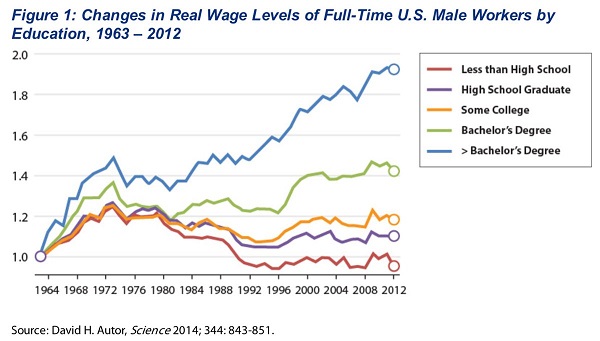 Surely doctors and professors are in that top blue line; I think nurses and teachers are in the lower green one. Plausibly these professions’ opportunity costs have gone up 50 – 100% during this period. This is a start to explaining why education/medicine have gone up 200 – 300% during the same time. On the other hand, the period of fastest wage growth was 1965 – 1975, which as per T&H’s graph (page 2) was the period of slowest cost growth.
2. Wages for doctors and teachers have not risen
Let’s start with teachers. T&H use NCES’ “instructional expenditures” category to show teacher wages have tripled since the 1950s; I cited NCES’ actual teacher salary data to show it’s stayed about the same. What’s going on?
NCES only has good data after 1990. Their data says education has become about 30% more expensive in real terms since that time – T&H’s data (page 2) suggests it has become twice as expensive, but their data on page 5 agrees with NCES (huh?). Here’s how various fields have changed, using two different classification systems:
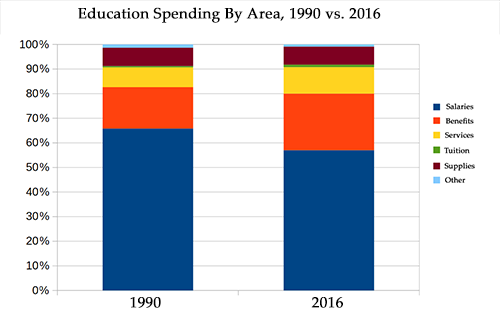
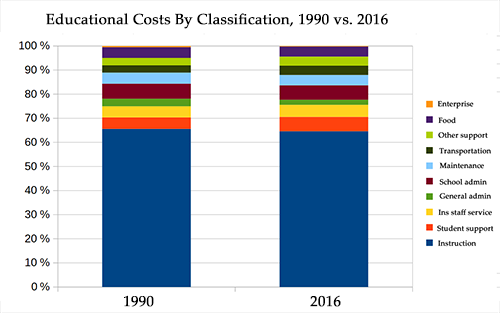 Pay attention especially to the first one. From 1990 to 2016, employee salaries as a percent of educational expenditures have gone down! Employee benefits have gone up a bit, but not enough: salary + benefits is still a smaller part of the education budget in 2016 than in 1990. How do you look at these data and say “We’ve figured out why education costs are rising and it’s definitely salaries”?
I think I miscalculated my tone when criticizing T&H’s presentation of data in their book. Tabarrok says I complained about areas “where [he] could have been clearer”. But my actual concern was that the presentation of this section misleads the reader. Whenever T&H talk about something other than salary, they emphasize that its share of the pie has not increased, but don’t mention that it increased a lot in absolute terms. Then when talking about salary, they emphasize that it increased a lot in absolute terms, but don’t mention that its share of the pie hasn’t increased. You’re left with the impression that salaries are the culprit for the price increases, when in fact salaries increased least of all the major categories in the data. “The data could have been clearer” is never just a minor gripe! Unclear data means you can prove whatever you want!
How are salary costs per pupil rising (even in proportion to other costs) if salaries are not? My guess is it’s all about decreasing class sizes, which T&H also highlight.
Moving on to doctors, I don’t have any equally clear sources. But I’ll at least try to explain more about the ones I already have.
This paper from Health Economics, Policy, and Law shows on page 15:
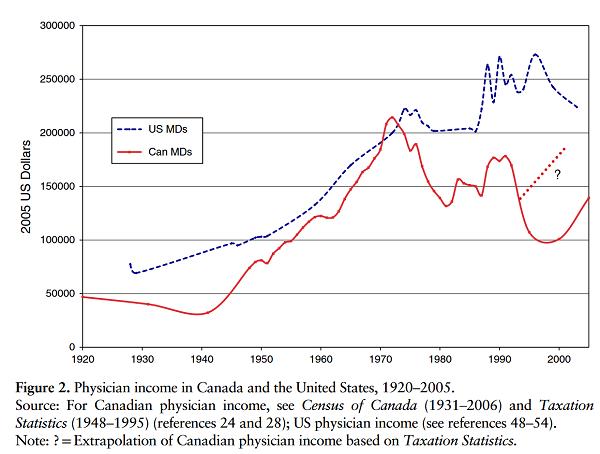 They cite their source as “references 48 – 54”, but their reference section isn’t numbered, and is in alphabetical order, which would make it a pretty big coincidence if reference 48 through 54 were all about the same thing. I think a wire got crossed somewhere. But taking it at face value, I eyeball US doctor salaries in 1960 as 130K and in 2005 as about 210K, for an increase of 60% (not the 200% T&H claim). Doctor salaries have been about stable since 1975, even as (according to T&H’s graph on page 2), healthcare costs have about doubled.
The Last Psychiatrist posts this image:
 I can’t trace the source beyond him, but read his post, where he notes that “There is the reality that doctor salaries (with notable exceptions) have been fairly static since 1969, even as the cost of living, price of homes, college, etc have gone up. And medical school debt.”
The last source I was able to find was this 1985 paper on doctor pay. It states that “In 1973, the median annual physician income was $45,000…by 1982, the median physician income was $85,000.” According to the inflation calculator, those numbers are $260,000 and $225,000 in current dollars, respectively. Estimates for average doctor salary today range from $209,000 to $299,000. I’m surprised how hard this is to measure, but it doesn’t seem to have doubled or tripled the way T&H claim (or the way it would have to in order to drive Baumol effects).
Also, the Baumol effect only works if the market sets your salary in the first place! Right now the supply of doctors is limited by licensing issues and bottlenecks in the medical education process; that keeps salaries high. Why would the Baumol effect drive that even higher? If doctors’ salaries didn’t increase in keeping with the highest-productivity industries, would medical schools sit empty? Given that the people setting salaries for doctors (hospitals, clinics) are not the people who determine the supply of doctors (bureaucrats, medical school deans), why should supply and salary be related in a way that obeys normal economic laws? I’m not really sure how to model this, but I’m pretty sure it doesn’t end with doctors leaving medicine to play violin concertos instead.
3. The Baumol effect cannot make things genuinely less affordable, but things are genuinely less affordable
I think I screwed up here.
The Baumol effect cannot make things genuinely less affordable for society, because society is more productive and can afford more stuff.
However, it can make things genuinely less affordable for individuals, if those individuals aren’t sharing in the increased productivity of society.
Suppose that in 1960, widgets cost $1, a worker could produce ten widgets an hour (and made $10 in wages), and violin concerts cost $10. Also, you are a farmer and make $10 per hour. You can listen to one violin concert per hour.
In 2010, widgets cost $0.50, a worker can make a hundred widgets an hour (and makes $50 in wages), and violin concerts have risen to $50. But you, still a farmer, still only make $10 per hour. The Baumol effect has driven up the cost of violin concerts for you.
This shouldn’t happen in real life, because if you work in the high-productivity-gain industries, you should make more because of your increased productivity, and if you work in the low-productivity-gain industries, you should make more because of the Baumol effect. But if it did happen, you’d be screwed.
And in fact, as mentioned above, wages have not increased in keeping with productivity, either in the high-productivity-gain industries like manufacturing, or in the low-productivity-gain industries like teaching. So if you work in one of those industries, it’s totally possible for you to be screwed, ie for college etc to become much less affordable for you.
If wages had grown in keeping with productivity, median yearly salary would be something like $100,000. Someone making $100,000 per year shouldn’t have that hard a time affording health insurance and college tuition for their kids; this would be the Baumol effect working in its normal, rising-tide-lifts-all-boats way. Since this hasn’t happened, Baumol-applicable industries have become harder to afford.
Again, this is all theoretical, because wages in high-productivity industries haven’t risen, so it’s hard to see how a Baumol effect could be happening at all. But if it was, it would be a good explanation for cost disease.
So I retract this third objection. I think the first objection mostly still stands, though it is a little weaker if we limit ourselves to college-educated workers compared to all workers. I think the second objection absolutely still stands, and it’s hard for me to see how T&H’s case could survive it.
