Invisible Women
Scott Alexander explores the puzzling lack of GDP impact from women's significant entry into the workforce, considering various explanations and economic implications.
[EDIT: Two readers – Pseudo-Erasmus and Noah Smith – have chimed in with very plausible explanations centering around labor force participation and productivity. See also my Mistakes page.]
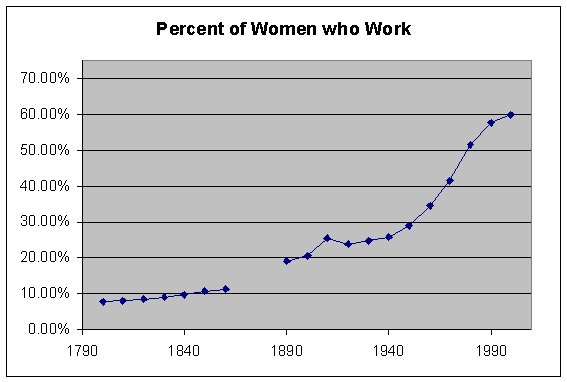
A commenter asked in yesterday’s discussion on The Two-Income Trap: why did the entry of women into the workforce produce so little effect on GDP? Here’s the graph of US women’s workforce participation:
 And here’s the graph of US GDP.
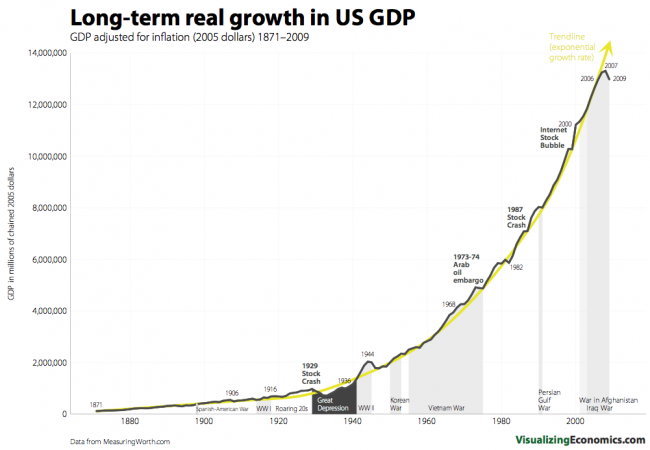 In about 50 years – 1935 to 1985 – we went from 20% of women in the workforce to 60% of women in the workforce. Assuming a bit under 100% of men in the workforce, that’s an increase of almost 50% over the expected trend if number of women in the workforce had stayed constant.
I’ve already admitted I find the fixedness of the GDP trend bizarre. But how on Earth do you unexpectedly raise the number of people in the workforce by 50% and still stick to exactly the same GDP trend? It would be like the US annexed Mexico one day but the GDP didn’t change a bit. Are we imagining here that if women hadn’t entered the workforce, GDP would have suddenly deviated downward from the trend, and totally by coincidence women rushed in to save the day? And then when we ran out of interested women to add to the work force, again by coincidence the GDP stabilized back to its trend line?
Possible solutions:
1. The GDP data is totally false. I am suspicious of that GDP data anyway. Maybe some joker in the Bureau of Labor Statistics just graphed out an exponential function and reported that as our GDP to see if anyone would notice.
2. The GDP data is low resolution. So low-resolution that even a change of 50% is invisible if stretched over a long enough time period.
3. Women contributed through unpaid labor in the home, and their paid labor substituted for that but didn’t add to it. But as far as I know GDP only counts paid-for goods. Not only should women’s labor in the home not have counted, but GDP should overcount the benefits of putting women to work because paid daycare and so on appear as valuable new services.
4. Somehow in total contradiction to usual economic theory, all gains made by women came out of the pockets of men, leaving the same growth as would have happened anyway.
This last one segues into a question asked by another commenter – did women entering the workforce drive down male wages?
This seems a lot like the question “do immigrants entering the workforce drive down native-born wages?” to which economists tend to answer “no” with more or fewer caveats. But the economists’ explanation for the immigrant effect is that in addition to producing, immigrants also consume, increasing demand.
Women were presumably already consuming. Back when they were housewives, they still needed houses, food, clothes, entertainment, et cetera. Their entrance into the workforce may create slightly more demand – for business clothes and office supplies, for example – but nothing like the demand created by immigrants entering the country.
If women increase the labor supply by 50% but don’t change the demand for labor, that seems like it should make wages go way down. Even if women are primarily in different jobs than men, men’s wages should still go down via a substitution effect (that is, even if women all become elementary school teachers, then a man who was planning to be an elementary school teacher before might become a fireman instead, raising the labor supply for firemen and pushing down fireman wages).
But the only study I can find to investigate this says it didn’t happen. And male wages don’t seem to have dropped dramatically starting 1950 or so. They do seem to have stagnated dramatically starting 1970 or so, but I feel like the income inequality explanation for that is on pretty solid ground. Unless you want to argue that the reason for income inequality is that between both sexes there’s now such a large reserve army of labor that the capitalists can get away with paying the workers very little. But I feel like economists would have told us if this were going on.
I hear a lot of conspiracy theories about women in the workforce. On the left, women in the workforce are being exploited and kept down by a sinister patriarchy. On the right, women in the workforce are a satanic plot to weaken our moral fiber.
But so far I’ve never heard the conspiracy theory that women never actually entered the workforce, that all the working women you see around you are animatronic robots or carefully crafted stage illusions.
Maybe this is the surest sign that the conspiracy is working.
