Practically-A-Book Review: EA Hotel
Scott Alexander reviews the EA Hotel, a project offering free accommodation to effective altruists in Blackpool, England, discussing its potential benefits and challenges.
Effective altruism (“EA”) is a movement dedicated to redirecting charity-related resources to the most important and successful charities. In practice this involves a lot of research into how important various problems are, and how well various charities work. Some of this research is done by well-funded official institutions. Other research, maybe exploring more unlikely scenarios or starting from weirder assumptions, is done as individual labors of love. These smaller-scale efforts might be self-funded, or supported by a few small donors. For example, Wild Animal Suffering Research, which investigates ways to improve the lives of animals in the wild, has yet to catch the attention of any hedge fund managers.
Like everything else, effective altruism is centered around San Francisco. San Francisco is the most expensive city in the world, so this isn’t very efficient; most of the relevant research can be done online from anywhere in the world. The official institutional charities eat the expense in exchange for the extra access to funders and other resources, but it’s a problem for small independent organizations. There’s been lots of research into possible solutions, but only if “let’s see how many people we can cram into one house in Berkeley” counts as “research”.
Blackpool is a beach resort in northern England. “Beach resort in northern England” is exactly as fun as it sounds, so nobody goes there. Everything is really cheap, and you can buy a whole hotel for the cost of a parking spot in San Francisco. Enter Greg Colbourn, an effective altruist and successful cryptocurrency investor. He bought the 17-bedroom Hotel Athena and wants to offer free room and board to researchers working on effective altruist projects
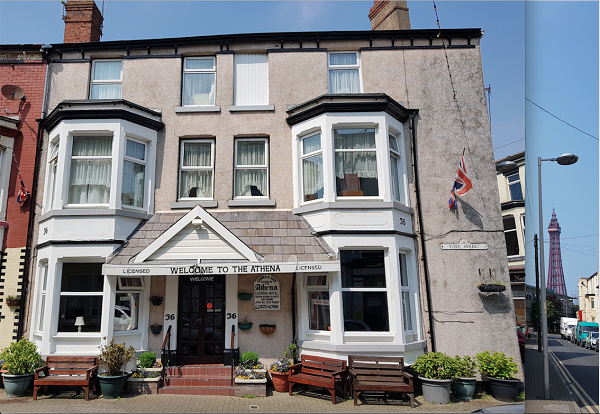
The plan is to make the E and A different colors than the rest of the word, eg ATHENA, for a double meaning.
Colbourn writes::
Do you long to be free from material needs and be able to focus on the real work you want to do? I know I’ve certainly been in that situation a few times in the past, but instead have lost time doing unimportant and menial jobs in order to be able to get by financially. Talented effective altruists losing time like this is especially tragic given that a lot of cause areas are currently constrained by the amount of quality direct work being done in them.
Buildings in the run-down seaside holiday resort of Blackpool (UK) are really cheap. I’ve bought a 17 bedroom hotel with dining room, lounge and bar for £130k. Assuming a 7% rental yield (which is reasonably high), this works out at about £45 per person per month rent. Factoring in bills, catering, and a modest stipend/entertainment budget, living costs could be as low as £5700/person/year (or lower for people sharing rooms, see budget). This is amazing value for hotel living with all basic services provided.
The idea is to invite people to live there, with all their expenses covered by donors, for up to two years. Funding is already in place (via me) for the first year of operations. The project will be managed by someone who lives on site and deals with all the admin/finances, shopping/cooking/cleaning/laundry, socials/events and morale – they will also have free living expenses, and be paid a modest salary. Note that this should be considered as a potential high impact, high prestige supporting role, for those excited to be involved in such a capacity on an EA mission. Guests will be free from concerns of material survival, and be able to have prolonged and uninterrupted focus on whatever projects they are working on. Obviously these will be largely limited to purely desk-based, or remote work.
Is this really more effective than just spending the money on grants that allow researchers to support themselves? If you know anything about effective altruism, you’ll have guessed that someone has already done the math on this. The hotel expects to be able to support people for £5700 (= $7300) / year, so:
For [giving people grants] to be equivalent, they would have to be living (or go to live) somewhere where the costs of living are comparable, otherwise I would effectively be buying them time at a much higher cost. For example, someone frugal living in London might be able to get by on £15,000 a year. So for the same costs they would get about a third of the time; and this is before factoring in the free time-saving services (cooking, laundry, cleaning etc). So unless they were ~4x as productive as the average hotel guest, this would be a bad deal for me as a donor. Also, the community aspect of having a significant number of EAs in the same place is probably worth something too in terms of increased focus, collaboration and morale boosting productivity. Community building via deeper in-person ties is becoming increasingly important to the further development of the EA movement.
Also, and in considerations I have to admit did not occur to me:
Blackpool might be hard to get to in the event of a catastrophe, but the flip side of this is that there would be a lower risk from hostile actors (mercenaries, milita), as well as lower direct damage from nukes and fallout…the cellars could serve as a nuclear bunker of moderate protection. It will be relatively low cost to keep a stockpile of long lasting food down there, which could be slowly used and replenished by the kitchen over a 2-5 year cycle. There is already bathroom plumbing down there, and other essentials could be easily added.
The hotel has another advantage, harder to explain. There’s a lot of concern in the EA community about Goodhart’s Law: “When a measure becomes a target, it stops being a good measure”. Think of it as “teaching to the test”, but for a broad and metaphorical definition of “test”. Or as cancer researchers who can’t research the most promising fields because they’re busy researching the fields that sound the best on a grant application, or the ones that will produce some small payoff in a year so that grantmakers classify them in the “productive” category and renew their funding. Or as the CEO who can’t pursue the most promising strategy because he’s busy pursuing the strategy that will maximize shareholder value next quarter. Effective altruism wants to avoid that failure mode. But as long as you’re in the business of distributing scarce resources to the people who seem to be able to use them best, you’re at risk.
It looks like the hotel wants to accept all comers who are making a good-faith effort to work on effective altruist ideas. I don’t know their exact plan or whether it will work. But having a low-barrier-to-entry hotel in an abandoned beach resort at least sounds less exploitable than giving people low-barrier-to-entry multi-thousand-dollar grants. The white paper says:
Scammers can be avoided, at least in the first instance, by requiring a prior history of involvement in EA and references from people with standing in the community. The bigger risk is well intentioned but ineffective grant recipients (/hotel guests) just not delivering. However, we are likely already in a situation where EAs frequently go off on their own to work on individual projects that don’t deliver, but we don’t hear much about it because of selection effects/social desirability bias
And:
Communal mealtimes will be encouraged though, as a way for camaraderie and a sense of community to develop amongst guests. Friendships will be formed, problems, and their solutions, discussed, and some amount of fun and laughter will be had too hopefully! Also, some people may find that the inevitable discussion of work that will arise will lead to some amount of peer pressure that will aid in keeping them productive […]
In terms of guarding against people becoming freeloaders (or effectively squatters), perhaps there could be a mandatory minimum of very brief (one page) reports on progress to be filed every three months. There would also be some indirect self-generated pressure from guests worrying about donors getting their money’s worth (although perhaps this will only be applicable for the more highly scrupulous). But then there would have to be a mechanism for chucking people out if they are achieving very little. The hard cap of two years on length of free stays per person will be an ultimate limiter, but it might be prudent to proceed with caution regarding taking on long term residents (perhaps a three month probation period would be useful).
Would people really want to live here? Apparently. In the month or two it’s been open, it’s already picked up three residents. The Facebook poll shows 115 expressions of interest, so if even a fraction convert to real bookings, they can keep their seventeen rooms full for a long time.
I have no idea if this project is a good use of anyone’s time or money, but I find it endearing. Part of this is of course the giant middle finger raised at Henry VIII – undissolution of the English monasteries and all that. But it’s also how I picture a near-term future where everything goes better than expected. A modest basic income could give everyone the opportunity to live a spartan but generally pleasant lifestyle in a friendly and meaningful community of intellectually-aligned people. As the old saying goes: “If it happens, it’s possible”.
Further links:
4. Apply to stay at the EA Hotel. Effective altruists are welcome to apply to live there for free; others are invited to pay for rooms at the usual rate if they want to go there on holiday / gawk at the interesting social experiment.
