The Parentheses Riddle
Scott analyzes a surprising age-related trend in responses to a parentheses riddle on the SSC survey, exploring possible explanations for why younger respondents were more likely to answer correctly.
Because I hate you, I included this question on the SSC survey:
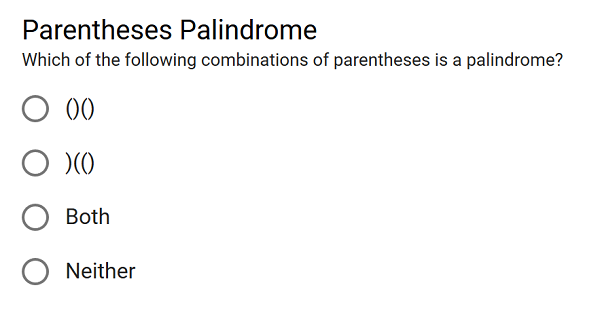 It’s a weird trick question, but I would say B is right. Imagine converting “(” to X and “)” to Y. Then the first answer is XYXY, and the second answer is YXXY. I suppose you could group the parentheses in pairs, in which case the answer would be “both”, but in practice few people wanted to say that. Of the 6,000 answers I received, most were either A or B. And one factor had a dramatic effect: age.
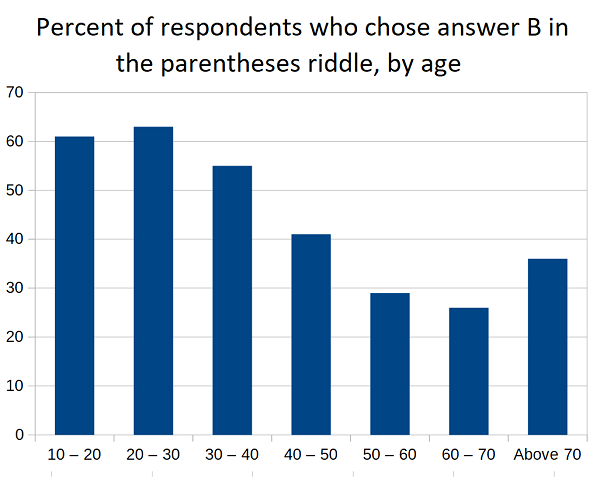 This is a big effect. People in their 20s were more than twice as likely to choose B as people their 60s. There’s a slight improvement after 70, but I think that’s just noise caused by a low sample size in that group.
My first thought was that the younger population on this blog is disproportionately techies, and techies have to work with very finicky parentheses all day. There was indeed a slight tendency for techies to do better on this, but it was a very small part of the effect. Even controlling for that, or limiting the analysis to only non-techies, most of the effect remained.
My second thought was that maybe this was an effect of older people gradually getting less sharp. But IQ itself was correlated with the parentheses question much less than age was. SAT score also didn’t correlate very well. And I would expect the most dramatic age-related declines to be after fifty, but the parentheses effect seems to – if anything – slow down then.
My third thought is that older people had less time to waste staring at a dumb survey and trying to solve everything exactly right. But the Squares And Circles Illusion also measures how long you’re willing to stare at a dumb question, and age was negatively correlated with this one. Big Five conscientiousness also did not affect parentheses answers.
I am pretty stumped by this. Right now my guess is that it is caused by age-related cognitive decline, but the connections go deeper than IQ – there’s something about age that affects the parentheses-reading faculty in particular regardless of how smart you are. I know there’s a medium-sized dementia-screening industry. I don’t know how good they are at detecting the normal level of cognitive decline in relatively young and intelligent people – but I would be interested to hear their opinion on this question and whether it has interesting properties beyond those they already know about.
EDIT: Commenters propose that young people might have seen the riddle before on Facebook or Reddit or some other young-person-Internet-place.
