Links 1/19: Linkguistics
A diverse collection of news items and interesting links covering science, technology, politics, and culture, with brief commentary on each.
If ant trails accidentally form a circle, ants can get stuck in an ant vortex forever, spinning themselves to death.
Maybe you’ve heard of Buran, the Soviet space shuttle. But maybe you didn’t know the story behind why it was built. NASA screwed up the space shuttle design process so completely that it was a bad match for pretty much all of its stated goals. The Soviets figured the Americans couldn’t really be that stupid, and so the shuttle project must just be a cover story for some amazing secret military capability America expected from having a space plane. They decided to build an exact replica so that after the amazing secret military capability was revealed, they could do whatever it was too.
New California law tries to fight “puppy mills” by declaring that pet shops can only sell rescued animals. In favor of this until someone convinces me it will have horrifying unexpected consequences.
Neo-Andean architecture in Bolivia.
Razib Khan discusses intelligence and reproductive fitness. Obviously great, but the real highlight, as with so many things, is the Von Neumann biographical tidbits. I often hear him brought up as proof that geniuses aren’t all socially inept, but apparently ‘When he proposed to [his wife], he was incapable of expressing anything beyond ‘You and I might be able to have some fun together, seeing as how we both like to drink.'”
Scientists claim to have engineered an improvement in photosynthesis that could boost yields of some crops by 40%. Really curious what priors we should have here over whether four billion years of plant evolution just missed a great idea for no reason.
RIP Judith Rich Harris, author of The Nurture Assumption and other works on child-rearing and psychology that inspired me and many of the other people here.
This week’s PayPal crackdown is on *spins Wheel O’ Mildly Unpopular Groups*…Satanists?
From the subreddit: What are some well-functioning, useful systems? It’s amazing how well basic infrastructure just works, despite everything.
Related: when a vital Bay Area highway collapsed and everyone freaked out about not being able to get to San Francisco, the local government hired “a contractor with a proven track record of rebuilding damaged freeways well ahead of schedule” and offered to pay them $200,000 extra for every day before the target date they finished. The highway was completely repaired in less than a month, in only half the government’s projected time estimate. This makes me confused about every government project that fails, goes late, or goes over budget – is it just that the officials involved weren’t as desperate? If there are known “hire these people when you really need it done right” companies, why don’t we just hire them for everything?
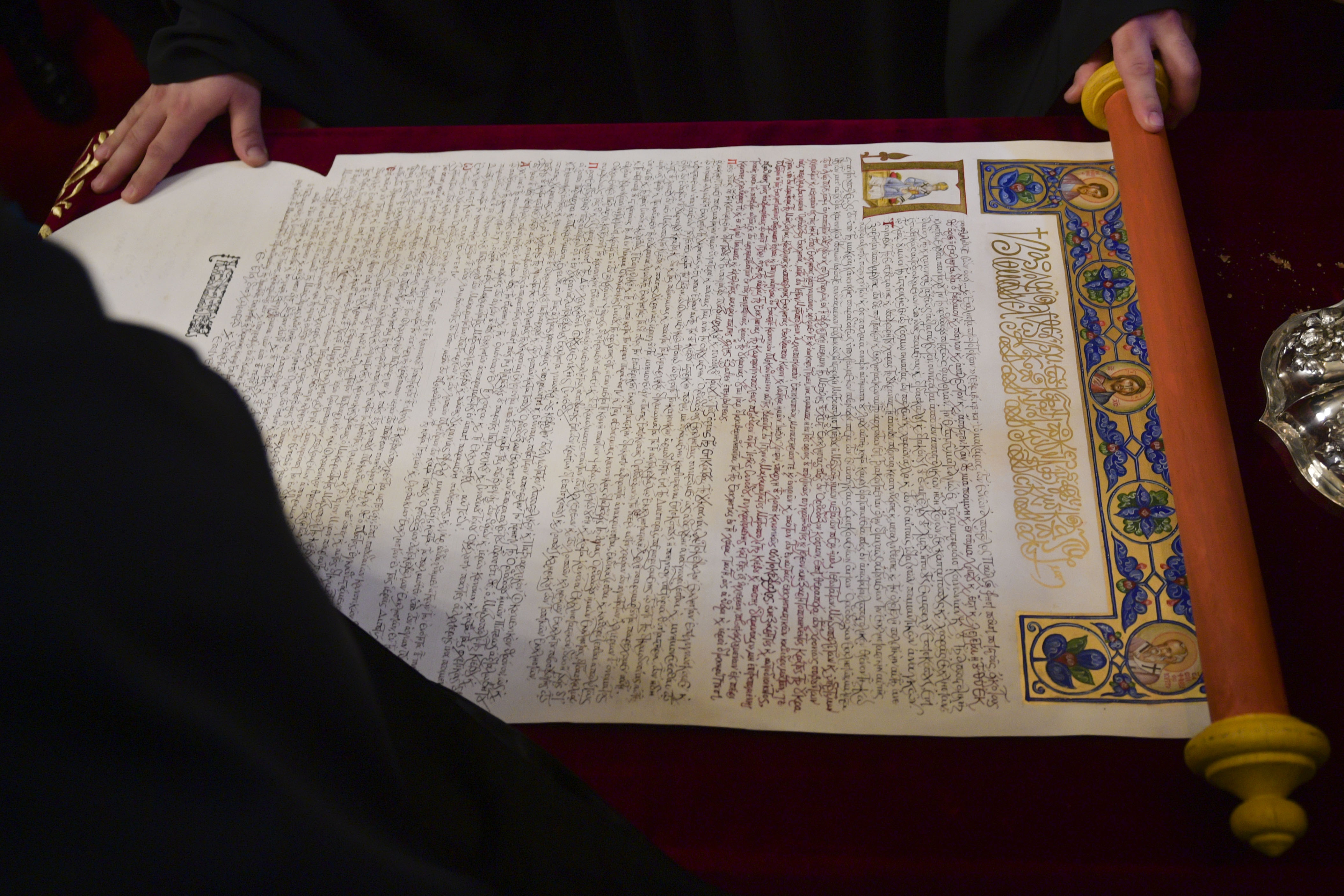
I can’t believe I’m turning into one of those people who relates to the news primarily through what the celebrities involved are wearing, but the highlight of the Ukranian Church getting autocephaly was definitely Metropolitan Epiphanius’ outfit. Also, the tomos of autocephaly as physical object. How come the Eastern Orthodox are the only people with good aesthetics? Related: pics of the new Coptic cathedral.
It’s Still The Prices, Stupid: Why The US Spends So Much On Healthcare. Team of economists argues that the specific way that US healthcare costs more than other developed countries’ is not because of higher consumption but because the same things cost more. Seems like a direct challenge to RCA’s actual individual consumption theory of health costs, interested to hear his response.
Related: Kevin Simler has a really interesting graph for why AIC is a better indicator for development than GDP
Washington Post is skeptical of the claim that Jeanne Calment faked her age; they make some good points about the evidence in her favor, but did they have to call the skepticism around her record “a Russian conspiracy theory”? And some provocative context for the debate: Errors As A Primary Cause Of Late-Life Mortality Deceleration And Plateaus (h/t ANDKAT on Discord)
Elon Musk reveals final design of Starship test rocket; 1950s cartoonists discovered to be 100% right about everything.
Impossible Foods unveils Impossible Burger 2.0, which critics say tastes even more like real meat; will reach restaurants in mid-March.
Team of psychologists including people named “Ditto” and “Zinger” find liberals and conservatives have the same amount of political bias. Glad we’ve settled that; let us never speak about this issue again.
For the past few years leading pseudoarchaeologists have been claiming that a pyramid in Indonesia is 30,000 years old, which would make it 20,000 years older than any other known building, and limit potential builders to pretty much Atlantis and Lemuria. As usual nobody paid attention to them. But now a team of scientists has investigated and found parts are at least 9,000 and “could even” be 28,000 years old, according to an an article in Scientific American which seems less surprised than I would expect. Has Scientific American gone the way of the History Channel, or is this important?
Why were the early American treasure hunting superstitions exemplified by Mormon founder Joseph Smith so similar to the Tibetan terton treasure-hunting tradition?
An embroidered computer sounds like some kind of hokey ploy to get more Women In Tech, but is actually pretty neat.
How have results on implicit association tests changed since 2007? I am usually kind of skeptical of this sort of thing, but this mostly fits what I would have guessed.
Several people pointed out my post on conspiracies accidentally recapitulated ESR’s idea of the “prospiracy”, so here is a link as atonement for the unintentional plagiarism.
New York Times points out that the number of monarch butterflies in California has declined 97% since the 1980s. This really hits home; I lived in California in the 1980s, I remember seeing monarch butterflies everywhere, and I never thought about where they all went until now. Scientists blame loss of habitat for milkweed, the plant the butterflies subsist on.
Related: more evidence that insect populations around the world have declined by 75%+. This is really scary and may literally represent the death of more than half the animals on earth (by individuals). Nobody knows exactly why it is happening, though one promising candidate is global warming since it’s hard to imagine what else affects everywhere in the world (including perfectly pristine wildernesses) at the same time. Some evidence that temperature variation has gotten outside the limits that insects’ physiology can tolerate. I would have hoped that each insect species would just move a few miles more polar and be fine, but apparently climactic adaptation is much more complicated than that and this doesn’t work. Again, it is kind of surprising that we are still alive after an eco-disaster of this magnitude.
Related? Bird and fish species all over the world are dying off due to thiamine deficiency. No one is entirely sure why so many animals all over the world are thiamine-deficient all at once, but it is being blamed for declines of up to 70% in various seabird species. Is this connected to the insect decline? Does anyone know how to check how much thiamine insects have?
www.decriminalization.org is the new hub site for a campaign to push towards decriminalizing drugs throughout the US.
Houthi rebels strapped a bomb to a drone and killed six Yemeni soldiers in what I think might be the first fatal drone attack by a non-state actor.
The big story in polling this month is the NPR poll showing Trump has a higher approval rating among Latinos than whites. Margin of error is enough to even these out but still not enough to rescue the standard racial narrative. This of course contradicts several previous polls (though all of those were pre-shutdown and the shutdown has changed a lot), as well as conflicting with the same poll’s observation that whites are still more likely to vote for Trump if they get a chance. Some good comments (scattered among many awful ones, as usual) from Marginal Revolution. [deleted a related link about racial bias in European countries based on comments providing evidence it was false]
New international study finds that doctors don’t tell people to lose weight enough, recommends educating doctors on the need to do this. I find this interesting because all the overweight people I know say they dread going to the doctor because their doctors never do anything else. “Help, I’ve been stabbed!” “Well, we’ll get to that, but first, have you considered that you’re overweight and need to diet?” There’s probably something really profound to be said here about different perspectives and sources of knowledge and whatever. See also the comments on Reddit, some of which are from primary care doctors.
Adam Fortunate Eagle is a Native American activist who, as a stunt, travelled to Italy, declared he had “discovered” it, and claimed it in the name of Native America. I feel like this is the obvious first thing to do if you are a Native American activist, and that all of the other Native American activists must have been kicking themselves for not thinking of it first.
WhatsApp limits ability to forward stories to a maximum of five people in order to prevent the spread of “fake news”. This kind of scares me because I heard of similar techniques being used in authoritarian countries like China to prevent protests from being organized and antigovernment ideas from spreading. I continue to be worried that worries about “fake news” risk being a perfect cover for increasing control over the media.
Hamilton fans and Hamilton detractors are locked in an eternal struggle to be more ridiculous and overdramatic than each other. Detractors have taken the lead recently as anti-Hamilton playwright Ishmael Reed raises funds to produce his new play The Haunting Of Lin-Manuel Miranda, about a bunch of Dickens-style ghosts explaining to Miranda why his play is bad and wrong. Bonus: Reed has never seen or listened to Hamilton.
The only useful commentary on Gillette’s controversial mid-January commercial is this Voxsplainer of the shaving industry from before the commercial even came out. It points out that Gillette has no idea how to compete with new low cost mail-order razors (even going so far as, in 1998, claiming it had a patent on the idea of “razor” and suing them in court) and has been flailing from harebrained idea to harebrained idea for years. It concludes that “The ludicrousness of today’s open [razor] market means, mostly, having the option to pay a lot of money for something or not a lot of money for something, without ever really approaching a concrete, evidence-backed reason for the decision.” See also this chart of Gillette profits. Alienating X% of your customer base, in exchange for inspiring Y% to keep buying your overpriced product forever in order to “own the cons”, makes sense under those circumstances.
This month in great names: leading Indian Air Force officer Aspy Engineer.
Another survey on expert predictions of AI timelines. I have only skimmed it, but right now I don’t find it very useful because of its decision to focus on in what year X percent of human tasks can be automated – for example, 90% will be automatable in 25 years and 99% in 50 years. I challenge the claim that any scientist has a principled idea of what “90% of human tasks” means, let alone an intuitive understanding of the difference between 90% and 99% of human tasks, and the survey didn’t ask about anything concrete.
Snopes introduces new “Factually Inaccurate But Morally Right” fact check result (THIS IS SATIRE). Also, I think Babylon Bee has successfully broken the “no conservative humor outlet is ever actually funny” curse.
Grant-writing is taking up an increasing amount of scientists’ time and energy, optimizing for grants is distorting research projects, and evidence shows that which grants get funded is basically random – there’s very low correlation in two raters’ assessments of grants, nor in raters’ assessment of grants vs. how useful that research ends up being. This has inspired a proposal: why not just assess grants as being above some basic standard of competence, and then use a lottery to determine which ones get funded? See paper, Voxsplainer, and MR post. Excited about someone trying to extend this to college admissions.
Related: this paper on competition (paper, LW post explaining paper) on some complicated ways of modeling a competitive process (like job interviews, college admissions, or grant funding) and how sometimes adding more competitors can make the average winner less skilled.
I don’t understand most of these cryptocurrency predictions for 2019, but anybody who does a bunch of gradeable probabilistic predictions for a field they’re an expert in gets a link here.
A really really pretty map of US wind patterns right now.