SSC Survey Results On Trust
Scott Alexander analyzes SSC survey results on trust, finding correlations with education, location, and political views, but not with gender, race, or religiosity.
Last post talked about individual differences in whether people found others basically friendly or hostile. The SSC survey included a sort of related question: “Are people basically trustworthy?”
The exact phrasing asked respondents to rate other people from 1 (“basically trustworthy”) to 5 (“basically untrustworthy”). 4853 people answered. The average was 2.49 – so skewed a bit towards higher trust. The overall pattern looked like this:
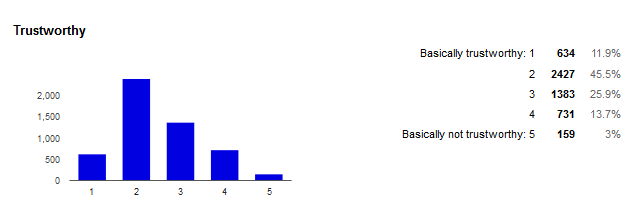 Trust didn’t differ by gender. Women averaged 2.56 and men 2.48, not a significant difference even with our fantastic sample size.
And I couldn’t detect it differing by race. Whites averaged 2.47 and nonwhites 2.59, which was nonsignificant despite decent sample size. Blacks were 2.81 and trended toward significance vs. whites, but the sample size was too small to be sure.
And I couldn’t detect it differing by religiousity. Committed theists (n = 506) had a trust level of 2.54, no more or less trusting than the average (and mostly atheist) SSC population.
And I couldn’t detect it differing by intelligence. There was no correlation between trust and either IQ or SAT score. There was a significant difference (p = 0.001) based on education level, all the way from PhDs at 2.35 to high school graduates only at 2.62.
There were some decent-sized differences among different US states, with more urban and liberal states being more trusting. Among the states with decent sample size, California (n = 608) was 2.43, New York (n = 298) was 2.47, and Texas (n = 143) was 2.75; the California/Texas difference was significant at p = 0.001. I was only able to eyeball rather than actually significance-test the urban/liberal correlation, but it looked pretty strong.
There were similar differences between countries. Germany (n = 192) at 2.35, the UK (n = 353) at 2.37, and Canada (n = 2.39) were all significantly more trusting than the US (n = 3124) at 2.53 – but obviously the effect wasn’t too impressive. There were only two non-western countries with remotely usable sample sizes. Brazil (n = 28) was 2.89, and India (n = 27) was 2.81. The non-western/Anglosphere difference was significant even with the low sample size. The most trusting city in the world was Toronto (n = 60), at 2.23.
There were so many professions, with such small sample sizes, that I wasn’t really confident any of them were much more or less trusting than others. But for what it’s worth, the number one least trusting profession, at 3.00, was mental health, and I am 100% not at all surprised. Otherwise there seemed to be a weak trend for nerdier and math-ier professions to be more trusting than others.
By politics, the ranking looked like this:
Social democratic: 2.38
Liberal: 2.40
Libertarian: 2.48
Conservative: 2.67
Communist: 2.80
Neoreactionary: 2.97
Alt-right: 2.97
Looks like the same trend of conservative = less trusting. Harder to figure out what to think about left vs. liberal, given the social democrats in the lead vs. communists very far behind.
Effective altruists who had taken the GWWC Pledge were much more trusting – 2.19 – than any other natural group I could find in this survey, more trusting even than Torontoans. After some work, I managed to find an unnatural group that beat them. Polyamorous Less Wrong readers from California – my proxy for the real-life Bay Area rationalist community – had a trust score of 2.13.
I had wondered if more trusting people would want less strict moderation, but the opposite was actually true – less trusting people wanted weaker moderation. Maybe this is mediated by conservativism – or maybe they just don’t trust me to moderate!
Autism, anxiety, OCD, and drug use all lowered trust; depression and bipolar disorder did not.
People who put down “Other” in any category were always much less trusting than any of the options, almost as if they didn’t trust people to accurately interpret the binned choices.
If you want to look into this yourself, you can find the data publicly available here, but be warned – predictably, the people who agreed to let me make their data public were systematically more trusting (2.49) than the people who refused (2.70).
